

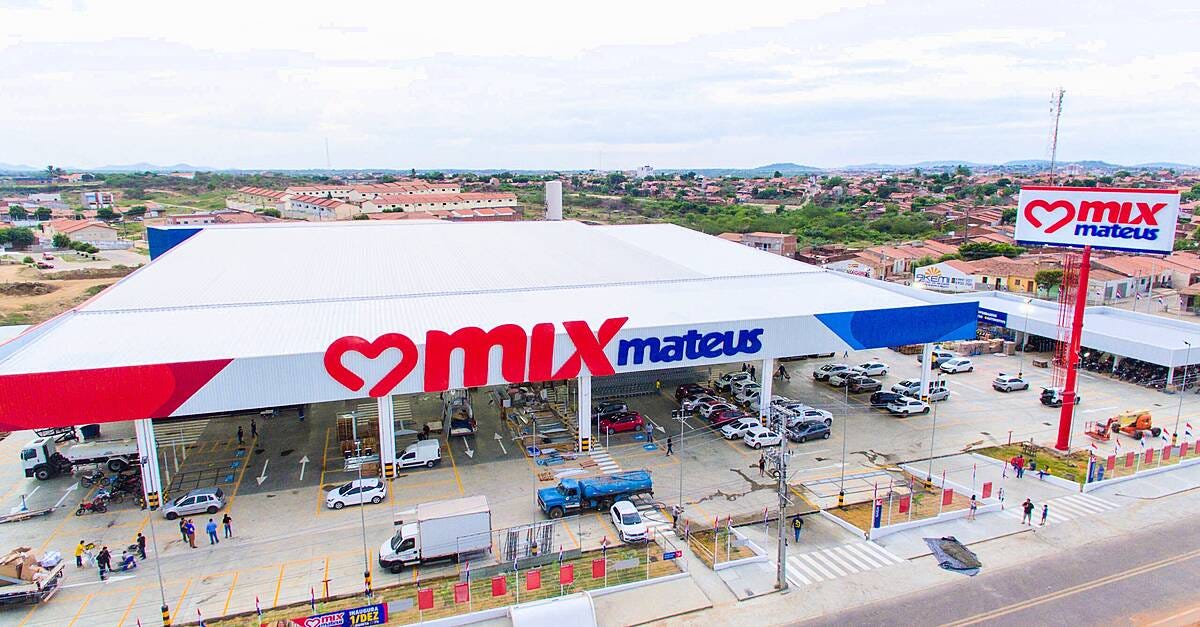
My deep dive into the grocery retail industry explored the history of grocery retail since the late 1800s, the product categories and their economics and highlighted 11 top quality listed grocery retail chains from around the world. Of these 11 companies, only one was valued below 10x earnings despite being of good quality with long-term growth prospects.
That company was Grupo Mateus, a Brazilian multi-format grocery retailer, founded by its current chairman, Ilson Mateus and is currently the third largest grocery chain in Brazil. Grupo Mateus is presently what I call a “triple-engine” stock, that is, a company that has good quality, high growth and is deeply undervalued.
Market cap (As of 28th October 2025): R$14.13 billion (R$6.3 per share)
Jenga IP 2029 estimated market cap: R$41.5 billion (R$18.7 per share)
Potential IRR (including dividends): 29.5% IRR
USD adjusted IRR (including dividends): 22.2% IRR
Jenga IP Quality rating: 70.4/100 (moderate moat)
Quality: The founder-led grocery store currently maintains the best store economics and efficiency among the major Brazilian grocery chains, leading to an industry-high return on equity of 15% and EBIT margin of 7%. It’s vertically-integrated, multi-format and maintains a strong and trusted brand with customers.
Growth: It’s historically doubled its revenue and profits every 3 to 4 years, and while this likely slows to every 5 years, its organic growth rate is still ahead of both domestic and international peers. Its revenue today (R$34 billion) is still half that of the next largest competitor, Assaí (R$77 billion), and a third of the market leader, Carrefour Brazil (R$118 billion). Its stores still haven’t reached some cities in its core north and northeastern regions of Brazil - a few locals I reached out to in Bahia, Brazil, had never heard of a Mix Mateus!
Value: At its current 9x P/E or 6x EV/EBIT, a valuation even too low for a no-growth average quality grocery retailer, Grupo Mateus is significantly undervalued relative to Brazilian retailers, global retailers and the broader market. I believe Grupo Mateus deserves a valuation multiple of 17x P/E, a significant upside from just a multiple revaluation over the next few years.
The 22.2% IRR on Grupo Mateus revolves around three key drivers:
Grupo Mateus proves to be a good-quality, growing business
Brazilian interest rates decrease from the current 15% rate over the next four years
The Brazilian Real depreciates by no more than 6% annually against the US dollar
Of these three, the most important is the first factor, Grupo Mateus’ business quality and growth prospects and for the majority of this deep dive, I will explore Grupo Mateus across the following topics:
Table of Contents
The Brazilian retail apocalypse: An overview of the state and key drivers of the ongoing drawdown in Brazilian retail. Grupo Mateus in relation to the listed retailers.
Grupo Mateus’ founding story: Insights into Ilson Mateus’ founder journey, Grupo Mateus in the 1980s and 1990s and growth path. An analysis of Grupo Mateus’ business and operational culture and strategy, recent hires and key timelines.
The geography and economics of northeast Brazil: An economic analysis of north and northeastern Brazil, key differences with Southern Brazil and its impacts on purchasing power, logistics and infrastructure. Insights into growth markets such as Bahia, Ceará and Pernambuco. Analysis of the potential store count in 10 years in each current state and an overview of Grupo Mateus’ 20 most recent new stores.
Brazil’s grocery and retail industry: An overview of the major supermarket chains, analysis into operations of key competitors including Carrefour, Assaí and Lider, the market structure and growth of the cash and carry (Atacarejos) format and other drivers of grocery retail—the impact of e-commerce (Mercado Libre, Shopee and Amazon) and overall industry growth prospects.
Insights into Grupo Mateus stores: A review of key features, dynamics and overall business model of the various Mateus store formats, from its cash and carry to its convenience stores. Analysis of its real estate positioning, a case study review and comparison of three Grupo Mateus stores relative to Assaí and Atacadão (Carrefour).
The business economics of Mateus: A breakdown of the operations and retail segments, store-level unit economics for a 4,000m2 cash and carry store and a 2,000m2 supermarket, the projected store-level gross margins and ROIC till store maturity. Analysis of its wholesale operations, key KPIs such as municipal zones, commercial representatives and logistics routes, and a broader overview of its profitability and reinvestment opportunity.
The growth opportunity: Assessment of Grupo Mateus store growth in existing core markets and newer states such as Bahia, Pernambuco and Ceará. Overview of potential investments in wholesale and assessment of its competitive positioning.
Risks and challenges: A discussion on key risks such as Brazilian tax credit adjustments, exchange rate exposure, the broader macroeconomics climate and its current balance sheet strength. How Grupo Mateus addresses its key risks and how I account for them in the valuation and earnings projections.
Valuation: Assessment of Grupo Mateus’ path to a 22% IRR
over the next four years and how I factor the exchange risks in the valuation model.
A short Brazilian retail investing journey
My interest in the Brazilian retail industry started three years ago, when I first discovered Track & Field, a sports apparel brand similar to Lululemon (see my notes here). At the time, Track & Field had a top financial profile (no debt, 20%+ earnings growth & EBIT margins), a strong brand and founding team, but was valued at half the earnings multiples of Lululemon. To me, that made no sense.
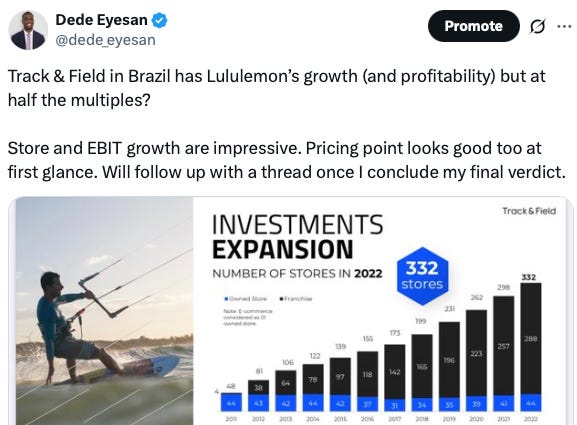
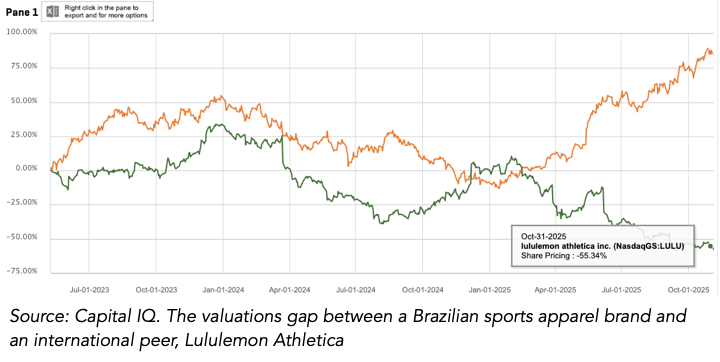
Two and a half years later, the market finally realised the valuation gap with Lululemon’s shares falling by 56% while Track & Field’s shares increased by 85% during the same period. This taught me an important lesson. The market can sometimes be inefficient for unexplainable reasons, and the only catalyst sometimes needed in an investment is time.
The relevance to Grupo Mateus is two-fold. First, I see Grupo Mateus in a similar situation. Like Track & Field, they went public in late 2020, experienced little investor interest after its IPO, and despite its far better than average business economics and growth in the grocery retail industry, Grupo Mateus trades at less than half the valuations of some other quality emerging market grocery retailers.
Second, during the Track & Field holding period, I noticed an interesting trend in Track & Field’s stock. For 18 quarters in a row, Track & Field posted double-digit revenue growth with double-digit EBIT growth in all but 3 quarters, yet the market never rewarded its performance. Between its IPO (November 2020) and May 2025, its shares stayed flat, despite earnings growing 4-fold. Domestic investors didn’t know the company, nor were they interested because there was an ongoing retail apocalypse forming.
1. The Brazilian retail apocalypse
As an outside investor looking top-down into the Brazilian market, you might think it’s firing on all cylinders. The MSCI Brazilian Index is up 40% YTD, doubling the return of the broader ACWI Index, and over the past three years, the MSCI Brazil has annualised 11%. However, looking deeper into the market presents a different picture. The median company has actually declined in value over the past 1, 3 and 5 years. The positive returns are mainly concentrated in the industrial, real estate and financials industries.
“Despite the Brazilian index returning 37% over the past three years, 59% of the 251 listed Brazilian companies with a market capitalisation above $50 million are in the red, with a median return of -9%.”
Looking closer into the worst performers presents an interesting observation. Of the 12 companies down by more than 80% over the last three years, 6 of them are retailers.
A population of 213 million people, a $2.2 trillion economy, and an emerging market. What’s not to like about Brazil’s retail opportunity? It depends on who and when you ask. For most participants in the retail sector, though, there’s a lot not to like.
Walmart: Bullish on Brazil’s prospects in the 1990s, Walmart entered Brazil in 1995 and reached a peak of over 500+ stores with multiple pharmacies and gas stations. However, they soon realised they had over-invested in store expansion but under-invested in logistics. The cash and carry stores or “Atacarejos” format brought additional competitive challenges, leading to Walmart selling its Brazilian operations in 2018 to the private equity firm, Advent International 2018, who in turn sold the operations, now rebranded as Grupo BIG, to Carrefour, the market leader, for a significant profit.
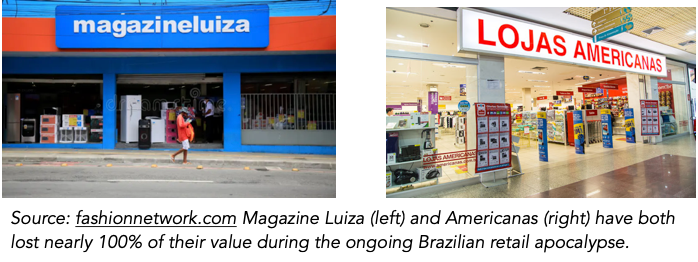
Americanas: At its peak, the 96-year-old department chain had over 1,700 stores, backed by 3G Capital, and was a case study for transforming a legacy retailer into a modern franchise. Between 2016 and 2020, its shares grew 9-fold, a 78% annual return, reaching a market cap of R$50 billion. What could go wrong? Only a couple of years later, Americanas admitted to hiding R$20 billion worth of debt from its balance sheet, almost half its peak market cap. They were placed into bankruptcy, with shareholders experiencing a 100% loss on their investment since then.
Magazine Luiza (MagaLu): Founded in 1957, MagaLu was another pioneer in transitioning a retailer from brick-and-mortar to digital and e-commerce. It was so successful that by 2020, it was often called the “Amazon of Brazil”, as its online sales grew 53% annually, from a 22% share of revenue to 64% within four years. However, as Brazil’s macroeconomics turned with higher interest rates and more intense e-commerce competition, MagaLu’s financials quickly deteriorated. From its IPO in 2011 to its peak 2020 valuations, MagaLu shares increased 52-fold, a 49% annualised return in ten years. Since that peak, MagaLu’s shares have lost 97% of their value, raised 85% of their current market cap in additional equity, added 100% of their market cap in more debt, and have reported earnings before taxes (EBT) losses every year since then. Like Americana, Magalu also later announced it had accounting errors in its bonus allocations.
Groupe Casino: Like Walmart and Carrefour, the French retail group entered the Brazilian market with the acquisition of Grupo Pāo de Açúar (GPA) in 1999, which included various retail brands, led by Assaí, the second-largest grocery chain in Brazil. However, the parent company had severe debt issues of its own, and to deleverage its balance sheet, it first spun off Assaí to its own entity in 2020 before selling its stake in the food retailer. Assaí wasn’t run as poorly as its peers, but to expand, it took on significant debt, currently valued at over twice its market cap, with its net debt/EBITDA reaching 3.8x. While revenue has more than doubled in the past years, operating earnings have stayed flat, as interest payments now account for 83% of its EBIT, from 37% four years ago.
Beyond these four companies, other Brazilian listed companies, such as Lojas Quero-Quero (furniture retail), Marisa Lojas (clothing retail), Veste, and Petz (pet food retail), have each lost over 85% of their share price in the past 5 years, and are facing deep structural balance sheet and debt issues.
As you would imagine, domestic and international investors have lost both capital and investment appetite for the Brazilian retail space. I’m told on Faria Lima (Brazil’s Wall Street), you don’t mention the “R” word (Retail) to any investor.
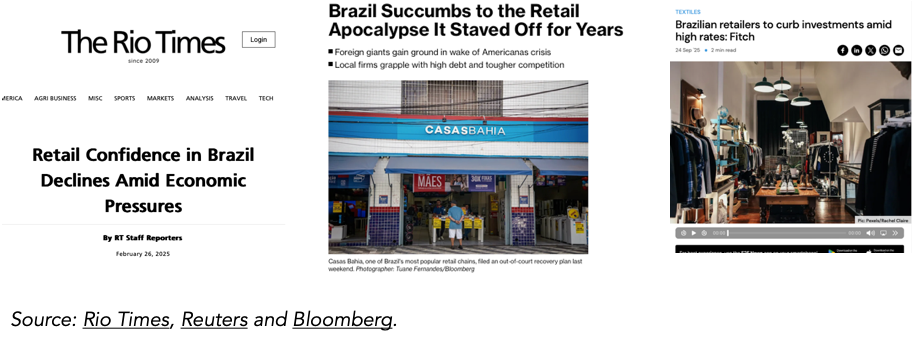
As a fundamental and value-driven investor, history shows that during these periods of industry-wide pessimism, it pays to investigate companies and differentiate the good companies from the bad ones. It’s this research that first led me to Track & Field and now Grupo Mateus.
Before diving into Grupo Mateus, it would be helpful to first share a table that highlights the current state of Brazil’s major retailers.
Financials of Brazilian retailers
The table below highlights 20 Brazilian retailers alongside their metrics in:
Profitability (EBIT margin and return on capital)
Debt (EBIT/Interest expenses and Net debt/EBITDA)
Growth (3-year EBIT growth and 3-year NI growth)
Valuation (Forward P/E and forward EV/EBIT)
Share price (3-year share price return)
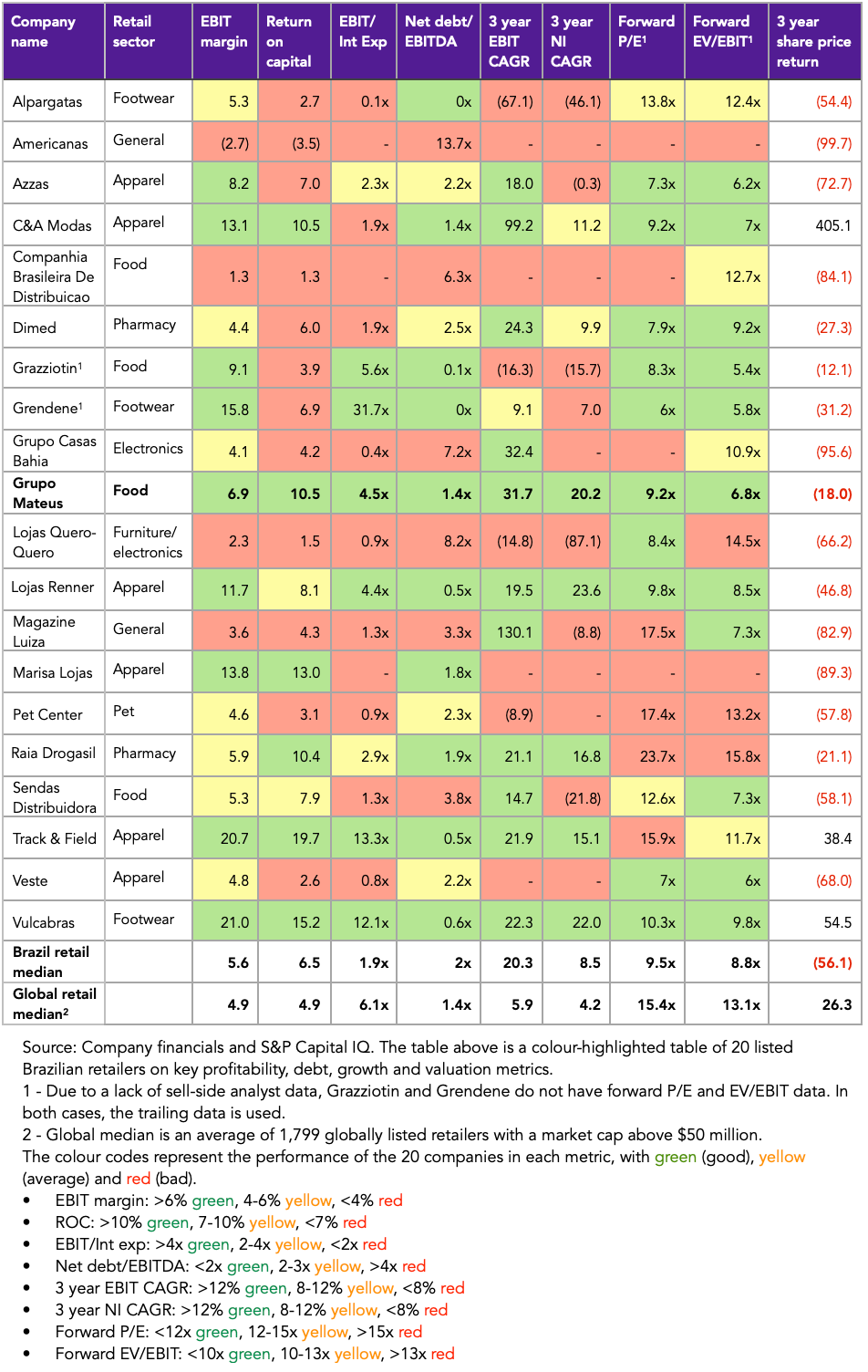
To support the analysis, I’ve colour-coded the table with green representing metrics that perform well, yellow for metrics performing average and red for metrics performing poorly. I’ve also included a final row highlighting the median global retail average across all 1,799 retailers with a market cap above $50 million.
A few things immediately stand out:
Share price return: Of the 20 companies, 17 have returned negative over the past 3 years, with a median return of -56%. During the same period, global retailers have returned 26% which means the Brazilian retailers have underperformed global peers by 82%.
Debt: Over the past five years, Brazilian interest rates increased from 2% to 15% and even among its emerging market peers, the pace of rate increase is unheard of. The rate change has a big impact on retailers, as on average, the 20 retailers spend 70% of the EBIT servicing interest expenses (1.4x EBIT/Interest expenses), versus 28% (3.6x EBIT/Interest expenses) in 2019. This means operating profits left for tax payments, shareholder returns, and reinvestments have almost declined to a third of the previous percentage in 6 years.
Valuations: The net effect of the share price decline alongside the debt challenge has led to a steep valuation drop. In 2020, the 20 retailers were valued at a median P/E of 39x (35x EV/EBIT). Today, that’s 9.5x forward P/E (8.8x EV/EBIT). Compared to the global retail average, the Brazilian retailers are valued at two-thirds of the broader market; 9.5x forward P/E versus 15.4x P/E.
In the middle of the table is the odd one out of the 20 companies, Grupo Mateus, the only company with a green colour (performed well) in all metrics while being priced below the industry average. Despite its performance here, Grupo Mateus is valued at 9.2x forward P/E and 6.8x EV/EBIT, even below the Brazilian retailer average despite achieving better profitability, much lower balance sheet debt and significantly faster earnings growth.
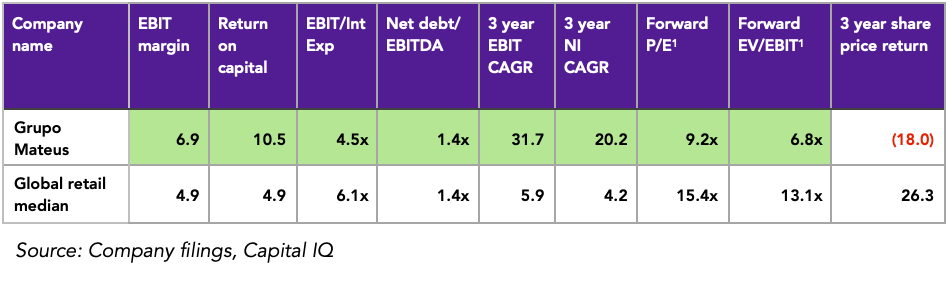
I believe this is an example of market inefficiency and sets us up for a deeper look into Grupo Mateus.
2. Grupo Mateus’ founding story
From my experience learning about grocery retail, especially in emerging markets, there’s a commonality among most countries. The best grocery retailers tend to be those owned and managed by domestic entrepreneurs, focused on regions with lower competition, which usually means areas with either lower population density or lower household incomes. They also tend to operate a creeping-growth model where they grow steadily into outer markets over a phased rollout approach.
“Domestically-owned + lower competition + store creeping model” = successful grocery retailers.
Three emerging markets were, however, exceptions to this rule: China, Brazil and Mexico. For each of these three countries, their markets offered the best investment case for international peers to enter and dominate before any local entrepreneur could. Mexico is right beside the U.S., which supported Walmart’s entry. Like China, Brazil’s large population quickly attracted international players like Costco, Carrefour and Walmart. However, unlike China, Brazil’s economic prospects didn’t match initial expectations, and lately, several international chains such as Walmart and Groupe Casino have exited the market, leaving room for smaller domestic players to win market share.
One of the domestic challengers is Grupo Mateus, the third-largest grocery chain. Today, more than half of Brazil’s population have never heard of them nor come across a Mateus store. I’m also told that the domestic financial community, based in southern São Paulo, are also less familiar with Grupo Mateus.
There’s a reason behind this. Grupo Mateus stores aren’t located in the higher-income and more populated Southern region of Brazil, where most retailers focus. It’s mainly based in North and northeastern Brazil. Its headquarters and almost half of its stores are based in the lowest-income state of all 26 states, Maranhão, a Brazilian state with just 15% of São Paulo’s population (7 million) and a quarter of São Paulo’s GDP per capita.
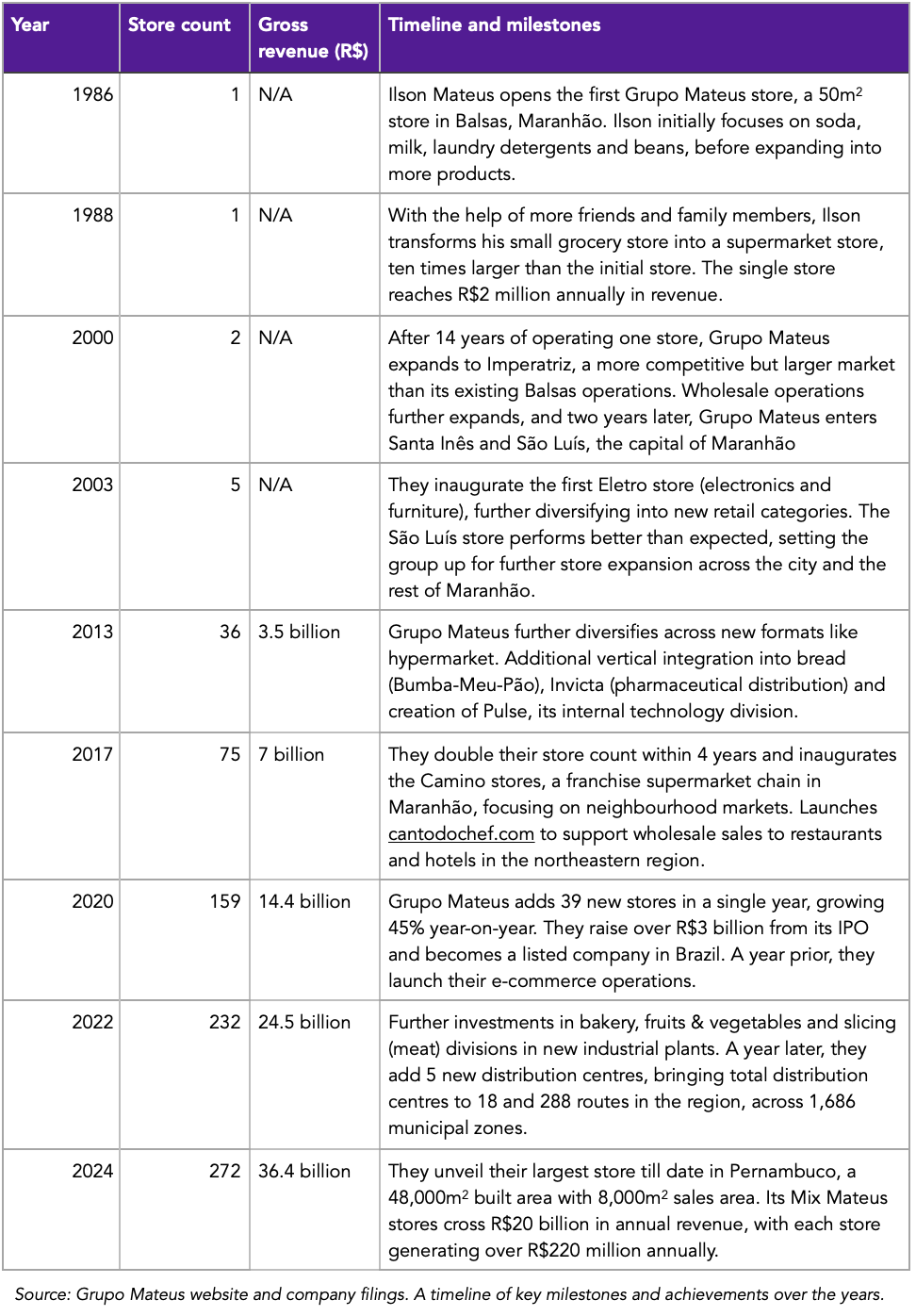
While it went public in 2020, seeming like a startup or new player, its journey goes back to 1986, led by its current Chairman, Ilson Mateus.
Grupo Mateus before Grupo Mateus (Pre 1986)
Paranoid, humble and frugal.
I rarely focus much on the upbringing of founders and management, but grocery retailing, being one of the most brutal and competitive industries, requires us to understand the background and culture of its origins.
In 1966, at age 4, after losing his dad, Ilson’s family moved to their grandfather’s farm in Maranhão, a northeastern state in Brazil. Struggling with learning to read and write, Ilson was sent to live with his grandmother in Imperatriz, one of the poorer parts of Maranhão, and it was at this life stage that Ilson credits his journey into entrepreneurship.
“I had to fend for myself, work many odd jobs ranging from bootlicking, sweet vendor, and lathe operator.” - Ilson Mateus, Grupo Mateus founder and CEO.
After dropping out of school and accumulating some income, Ilson tried his hand at very small-scale entrepreneurship but quickly went bankrupt twice. These failures were important for him as they taught him a big lesson on debt: avoid it when possible.
“Having gone bankrupt twice, I’m now terrified of debt. We IPO’d to avoid raising more debt.” - Ilson Mateus.
While working at a Coca-Cola factory in the early 1980s, a friend mentioned to Ilson about the growing opportunity in Balsas, another city in Maranhão. The local Soybean market had just started booming, and after his first visit, Ilson realised there was some opportunity for commerce here.
In October 1984, Ilson swapped his Chevrolet A10 for a truck and started buying soda drinks and Cachaça (Brazilian rum) from Imperatriz while selling in Balsas. The first trip had 70 cases of soda, all of which sold out on the first day, and the next day, he returned with 200 soda cases. With more capital, he diversified into more products like milk, laundry detergent, and selling door-to-door, often to small businesses and large families, which birthed the wholesale segment Grupo Mateus today, currently accounting for 18% of the group’s revenue (R$6.3 billion).
This period was a particularly challenging period for Brazil; the 1980s were the “lost decade” with stagflation, high domestic debt, resulting in the Cruzado Plan. This didn’t slow Ilson down, and a year later, in 1985, he purchased a second truck for general merchandise. After an opportunity opened to buy land for a grocery store in 1986, Ilson opened a 50m2 grocery store with his then-wife, Maria Pinheiro, who currently holds a 15.3% stake in the group, running the grocery store day-to-day.
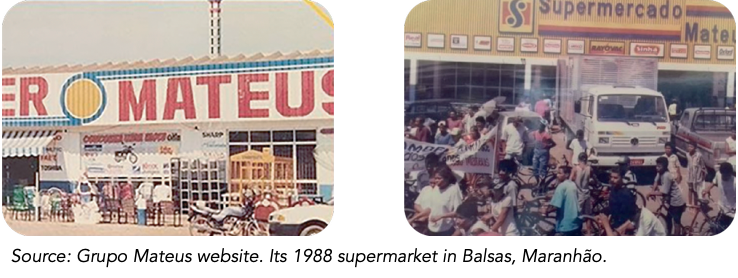
“When inflation was that mad, I sold 100 cans of soda in the morning and closed the market so I could buy 110 cans in the afternoon.” - Ilson Mateus.
The foundations behind Grupo Mateus are central to its success to date. Most staple retailers usually pick between wholesale and supermarket stores. And if they focus on supermarkets, the logistics network usually comes after, not before the store.
Grupo Mateus did the opposite of what most supermarkets do. First, it’s always maintained wholesale operations, selling to other retailers and small businesses while also growing its consumer-oriented grocery store. The benefit of this is that it keeps its inventory, distribution and operations quite flexible, allowing Grupo Mateus to be more resilient during downturns where one segment often becomes more hurt than the other.
The other key difference is Grupo Mateus’ decision to build the logistics capabilities before the store. Ilson says this was of necessity as there was no other way for them to have succeeded in northeastern Brazil. The key benefit of the logistics-first approach is that it brings further flexibility to the group. Today, Grupo Mateus is in multiple formats with convenience, supermarkets, cash & carry and specialists (furniture & electronics). The distribution and logistics team employs over 5,000 people, split into specific routes with 9 distribution centres (more discussed in section 6, business economics).
Grupo Mateus 1986 - 2003 (A 50m2 store to 5 stores)
After a couple of years of operating the single 50m2 grocery store, Ilson moved the operations into a larger store in 1988, but there were some key retail lessons before this transition:
Customer first: As Ilson often recalls, the customer is always the boss. Grupo Mateus built a great rapport with customers for several reasons. First, they were among the first local players to accept credit payment. Although risky, Ilson realised “credit was worth more than a smile” and he could gain respect and trust with customers via credit. He also carefully diversified into more products, mainly at the customer’s request, ensuring their needs were met.
Long hours, intense work: He worked tirelessly. In an interview a few years ago, Ilson recalled often going three nights without sleeping. To keep costs as low as possible, he worked in several parts of the business: as a truck driver, an inventory manager, and a customer support representative. He visited several wholesalers in Imperatriz to identify the best fruit and vegetable prices, among other tasks. The combination of his frugality and intensity supported the economics of a store in Brazil’s lowest-income state.
Reinvest: Despite being the third-largest grocery chain in Brazil, Grupo Mateus still doesn’t pay a significant dividend; just 1% of the profits earned since going public in 2020 have been paid out. The culture of reinvesting all excess profits into stores and growth opportunities goes back to its early days. Frugality is necessary in grocery retail, and it doesn’t get more frugal than him.
As friends and family came on board, the single store grew, reaching R$2 million in annual revenue. The focus was primarily on this one store and the wholesale operations until the 2000s, when they first entered Pará, a state west of Maranhão and then Piauí, Southwest of Maranhão. By 2003, Grupo Mateus had five stores, setting the business up for its next phase.

2003 - 2020 (5 to 159 stores)
During this initial expansion phase, Ilson realised most grocery stores in the nearby cities of Maranhão were mainly run by cattle ranchers who opened a store on their excess land. Most of these stores lacked expansion capacity or an operational structure. To ensure they were the first organised retailer, ahead of the national chains, they expanded rapidly across Maranhão.
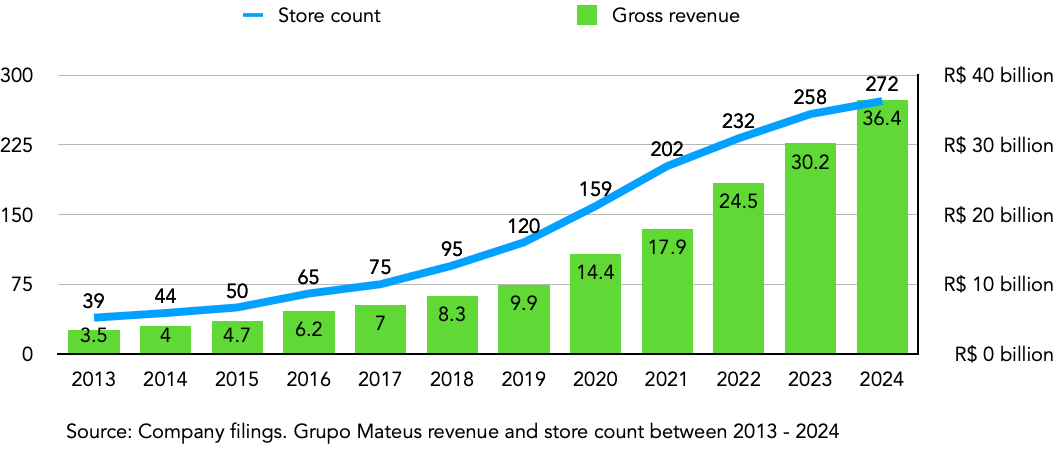
Between 2003 and 2013, Grupo Mateus had grown from 5 to 39 stores, with revenues reaching $3.5 billion that year. The process of consolidating the lowest-income cities in Brazil brought further lessons and business changes for Grupo Mateus. For example, Pará, the 1.2 million population state, was particularly tough logistically for Grupo Mateus. Ilson realised he needed to integrate specific product categories vertically, and in 2007, Grupo Mateus launched Bumba-Meu-Pão, its own private label bakery operations, now called Bumba, to supply all stores.
There was also a gap in the electronics segment, but selling these within the existing Mateus stores wasn’t as profitable, so in 2009, Grupo Mateus launched its Eletro brand to target the electronics and furniture market. Today, Eletro has 104 stores, representing 3.5% of Grupo Mateus’ revenue.
The store growth model was also a key learning point. Given that Grupo Mateus was in different categories, it needed to be careful about which store format it entered and its variations. For example, in Maiobao, Maranhão, they noticed existing grocery retailers didn’t have much refrigeration space, so to compete, Grupo Mateus reduced the store’s service area (restaurants and snack food) segment while increasing the refrigeration space by 30% to win market share.
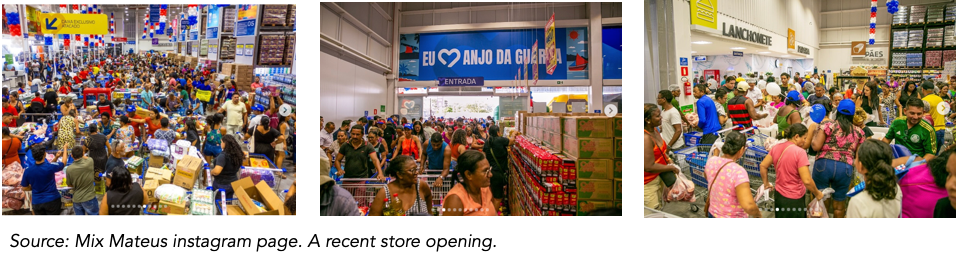
Another important lesson was the use of day one promotions as the core marketing strategy. Grupo Mateus doesn’t engage in expensive nationwide or TV campaigns (marketing is 0.4% of revenue) and typically relies on aggressive promotional campaigns on the store inauguration day. It’s common for locals to postpone grocery shopping for weeks, anticipating the store opening. The pictures below are from a recent store opening day in São Luís city, the capital of Maranhão, just a couple of months ago, and you can see how packed it is on day one.
The most crucial learnings were its insights into people. The culture and staff make or break a retail company, and in 2011, Grupo Mateus created ULMA, a Mateus leadership university where managers are trained so they can assume leadership positions within the company. On their YouTube page, you can watch over 8 hours of content from current staff discussing some learnings on management at Grupo Mateus.
By 2020, Grupo Mateus had now reached 159 stores, with its gross revenue growing at a 25% CAGR to R$14.3 billion, with no outside investors. Then came its IPO at the end of the year.
2020 - present (159 stores to 272 stores)
Ilson’s prior bankruptcy experiences as a teenager created an aversion to debt, and by 2020, national chains like Assaí started eyeing a larger share of sales in the north region. From my research into Ilson, after debt, his next biggest fear is competition. In one interview, he mentions “getting killed by competitors” almost five times in 2 minutes.
The fear pushed him towards an IPO in late 2020, which raised R$3 billion in new equity to support current and future expansion plans. Over the next four years, Grupo Mateus delivered on its targets with its stores growing by 14% annually, while revenue grew at 26% annually. More impressive was Grupo Mateus’ performance at the profitability and efficiency level. Operating profits grew at 25% per year between 2020 and 2024, with its EBIT per m2 further accelerating from R$2,700 to R$3,300.
Today, Grupo Mateus achieves an annual revenue of R$36.4 billion, split across four key business segments and is among the most well-funded and most efficient retailers in Brazil. Before getting deeper into the business economics, competitive landscape and economics of northeastern Brazil, it’s vital to share some more insights into the culture at Grupo Mateus.
Culture at Grupo Mateus
On the Jenga IP Quality Index’s culture segment, which explores the company culture from employee attrition, compensation, management track record and ownership alignment, Grupo Mateus scores 8.2/10, one of the highest among my shortlisted retailers.
Leadership and ownership
At the top is Ilson Mateus, the founder and current chairman, who recently passed on the CEO role to Jesuíno Martins, the current CEO, a 28-year company veteran who joined the group in 1997. During the handover, Ilson Mateus said the transition was 10 years in the making and Jesuíno was someone he had mentored and trusted to lead the group. Another key leader is Ilson’s son, Ilson Jr, the vice chairman of the group and one of the three key owners alongside his brother and mother. Altogether, the Mateus family own 78% of the group and hasn’t sold shares since it went public in late 2020.
I’m quite pleased with Grupo Mateus’ overall culture. It has relatively low attrition rates, especially when compared to its larger rivals, Assaí and Carrefour. 6 in 10 administrative employees have been there for over 10 years, and my research shows that there’s lots of room and a track record of internal promotion, re-skilling and growth.
From my LinkedIn searches, below are some key lieutenants in top management who have worked at Grupo Mateus for over 15 years:
Aldo Oliveira: Joined in 2002 as a sales representative and was promoted to the national director of operations.
Leandro Souza: Joined in 2004 as a manager and is now an executive director.
Tony Lima: Joined in 2008 as a commercial manager and is currently a regional director.
Railma Lima: Initially joined in 2006, within the HR department, left for a year, before returning to the company in 2022.
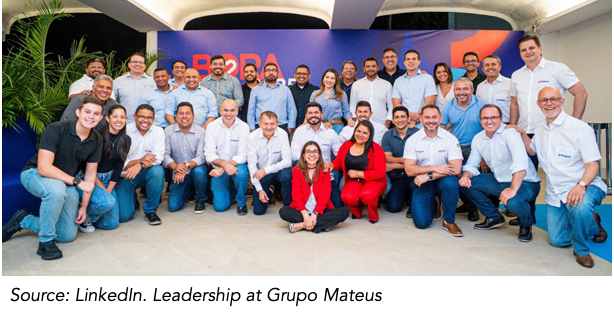
Three key challenges Grupo Mateus faced after its IPO in 2020 were corporate governance, expansion, capital allocation and being able to speak the Faria Lima language. To solve this, the company brought a new CFO, Tulio Queiroz, from Riachuelo (after 16 years tenure), a Brazilian listed apparel retailer, Sandro Oliveira (VP for operations) to support its expansion plans (I’m told he has deep expertise of the northeastern region) and additional staff in the legal and compliance department from other retailers like Paula Bonanno. In technology, Ramon Veloso was brought in to lead their e-commerce and technology efforts after they acquired his startup.
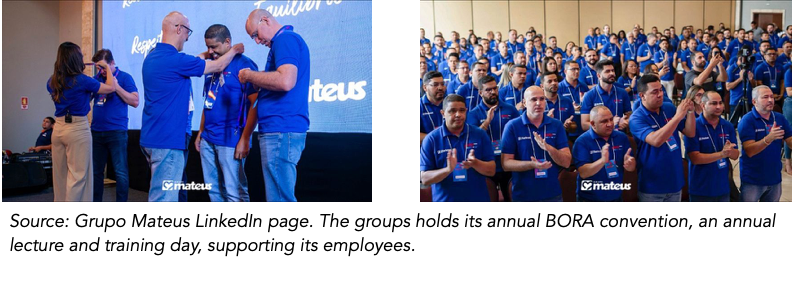
Overall, while corporate governance remains an issue, the cost of investing in a business with 78% insider ownership, the level of reporting, shareholder access and KPI clarity has certainly improved since its listing.
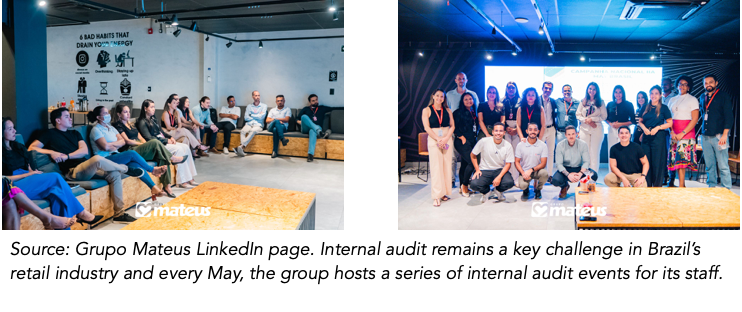
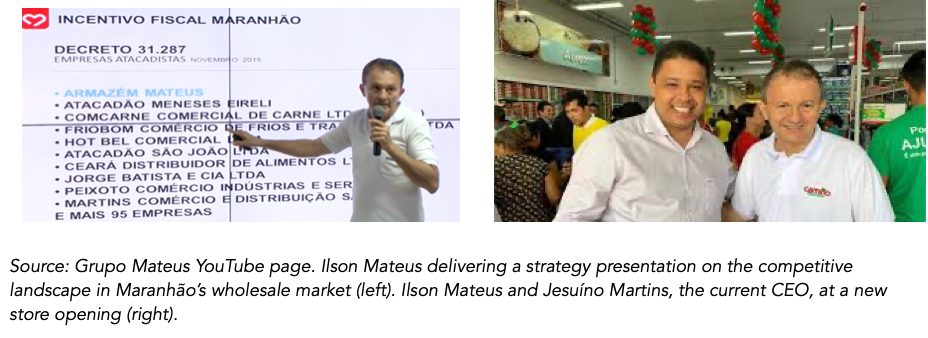
Today, Grupo Mateus employs over 56,000 people in the north and northeast regions, often among the largest employers in many of its cities. While there’s undoubtedly been difficulties along the journey, such as the death of an employee after shelves collapsed at a store, an ongoing R$1 billion tax dispute (more on this in the valuations section), failure to meet health regulation practices in São Luís, Grupo Mateus’ performance and culture sits well ahead of its peers and the broader Brazilian retail industry.
3. The geography and economics of northeastern Brazil
While there’s certainly market pessimism for the Brazilian retail industry, the investment case for Grupo Mateus is not predominantly macro-driven. That said, it’s essential to consider the macro picture as it undoubtedly impacts the investment decisions, profitability and growth prospects for companies, especially retailers.