


Due to the length of the report (75 pages), a more accessible PDF version is attached at the end of the article, alongside the software industry, data centres and cloud services data sheets.
Like many readers and value investors, I’ve been carefully watching the current software downturn, researching and pondering on how these companies might evolve in a more AI-driven world.
Admittedly, I’ve become more wary about the future of software. Until recently, software seemed like a no-brainer. These businesses were asset-light, highly profitable, with low incremental costs and could grow via both organic and M&A channels.
Although far from being mutually exclusive, AI challenges the traditional economics of software by directly targeting both the number of employees at companies (volume, fewer seats) and revenue charged per user (price, lower ARPU), driven by the potential productivity gained from AI across teams, the unbundling of previous distribution channels and increased competition for a share of technology budgets.
Of course, not all software is created equal, and AI will further enable some. Factors such as workflow embeddedness, providing mission-critical solutions, having solution offering breadth, being financially robust and disciplined will differentiate software companies. After further research and assessing an initial shortlist of software companies, I concluded that the largest, Microsoft, had an attractive risk/reward and initiated an investment position in its shares.
Market capitalisation (As of 9th March 2026): $3.04 trillion
Jenga IP 2030 FY estimated market cap: $5.6 trillion
Potential IRR (including dividends and buybacks): 16.7%
Jenga IP Quality Rating: 84.2/100
More specifically, the Microsoft investment case rests on five key questions:
The Microsoft investment case questions
Can Microsoft maintain its software margins despite a more capital-intensive business model?
Will Azure remain a high-margin business or evolve to utility-like infrastructure economics?
Will Copilot meaningfully expand the ARPU potential across Office 365, or does customer seat loss prove more meaningful to its bottom line?
Can Microsoft retain control of enterprise workflows, or does AI shift value to new platforms?
Does AI strengthen or weaken Microsoft’s moat due to software and workflow commoditisation?
To answer these five questions, here’s what I’ll cover in the Microsoft deep dive:
Table of contents
History of Microsoft: A summary of Microsoft’s history, efforts in building enterprise software across its four management phases (Bill Gates, Steve Ballmer, Satya Nadella 1.0 and 2.0). Case studies on Microsoft’s challenges over the years and insights on its transition from the license model to SaaS, its early AI efforts, and a conclusion on the current state of its competitive advantages (distribution and bundling, balance sheet and Azure’s switching costs).
Overview of Microsoft’s services: A breakdown of Microsoft’s product and service offerings and their performance relative to competitors, further overview of the past transition from license to SaaS and benefits gained, a deep dive into Azure’s cloud offerings and market position, Copilot and Microsoft’s broader AI offerings in focus and the enterprise perspective of Microsoft (M365, Azure, Dynamics, security, Windows and GitHub & developer tools).
Enterprise software industry: An overview of the global enterprise software industry and a deeper analysis of Microsoft relative to other first-generation software companies (Oracle, SAP, Intuit and IBM), the broader commercial software business and productivity tools market (Alphabet Workspace and WPS) and the challenge from AI-native companies (Anthropic and OpenAI) to traditional enterprise software.
Inside Microsoft’s AI and data centre efforts: Insights into the current data centre and cloud computing market, a value chain overview from land permit to deployment, assessment of current competitors (Amazon, Alphabet and neocloud players), token economics and the Microsoft Fairwater strategy, the developer platform and its role in Microsoft’s AI efforts (GitHub Copilot, Visual Studio and OpenAI partnership) and the shift in market dynamics by AI layer (infrastructure, platform, applications and control points).
Business economics: A deep dive into Microsoft’s business economics by revenue (service type, business segment and geography), costs (cost of revenue, operating costs and Capex), assessment of the current state of Microsoft 365 competitiveness and strategy, Azure and Azure AI’s efforts and unit economics and a competitive landscape and further insights into LinkedIn and Gaming.
Growth opportunity: Analysis of its growth drivers (seat, ARPU and usage) across each business segment (server products and cloud services, commercial - insights into E5 to E7 and Copilot - and consumer products and cloud services, LinkedIn, Gaming, Windows and Devices, Search and News Advertising, Dynamics and Enterprise services), an overview of the changing cost profile to its operating margins.
Risks and challenges: Further assessment of Microsoft’s transition into an asset-heavy business model, coopetition with OpenAI and Nvidia, an overview of the talent market among Big Tech companies, AI operational gaps to Alphabet, impact of a potential slowdown in AI at the enterprise level and concluding thoughts on its evolving value chain and other risks like cloud commoditisation, pricing pressure, lack of frontier model ownership, changing software architecture and the evolving regulatory landscape.
Valuation: An earnings multiples-led valuation and projection of Microsoft’s earnings potential through to 2030 FY, comparison with peers and the broader software industry.
Conclusion: Final thoughts on the broader software market downturn and concluding answers to the initial five Microsoft questions.
1. History of Microsoft
Microsoft’s journey to becoming among the greatest businesses of all time has been well documented in books, media and documentaries. Rather than attempting another history lesson, to stay relevant to its investment case, it’s more useful to focus on the competition and challenges it’s faced to date. To achieve this, I will assess Microsoft through the eyes of its competitors and partners over the past three leadership reigns: Bill Gates, Steve Ballmer and Satya Nadella.
Bill Gates (1975 - 2000)
IBM (1980)
Although Bill Gates and Paul Allen had founded Microsoft five years before the key 1980 partnership with IBM for IBM’s PCs, the contract was the pivotal start for Microsoft in the operating software market. As described by the media, IBM was the “sun, moon and stars” in providing technology solutions to businesses and to defend itself against growing competitors, IBM launched “Project Chess” to build a PC suitable for businesses, and after failed negotiations with CP/M, IBM turned to Microsoft to build its operating software. Microsoft didn’t actually have an operating system, and Bill Gates swiftly acquired all rights to 86-DOS from Seattle Computer Products and then repackage the OS for IBM.
Beyond being technically savvy, Bill Gates was also a capital allocator and had a strong sense of acquisitions that could bolster Microsoft’s software position, and when both skills are combined, the opportunity is limitless. The IBM partnership propelled Microsoft, and between 1979 and 1985, Microsoft’s revenue grew at a 97% CAGR to $140.4 million with an impressive EBIT margin of 29%.
IBM had also benefitted from the partnership and sold over 500,000 PCs over the first 2 years, becoming the market leader, but the mistake they made was that they underestimated Microsoft’s ambitions, the value of owning your operating software and the commodity nature of PCs. As Microsoft began expanding its own commercially successful Windows OS during the mid-1980s, tensions increased between IBM and Microsoft and by 1990, IBM ended its relationship with Microsoft, deciding to take full control of the OS/2 and build its own OS internally.
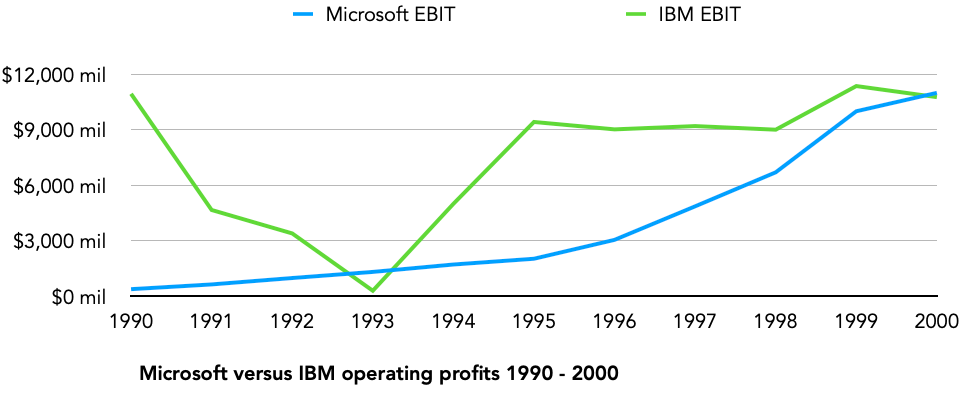
IBM faced a more important challenge. Its PC architecture was too easy to clone, leading to many new OEM entrants into the PC market. By the end of the 2000s decade, Microsoft had eclipsed IBM’s operating profits, from being 4% of its EBIT in 1990.
“Eventually we need to have at least a neutral relationship with IBM.” Our strategy is Windows, 1991 memo by Bill Gates
OEMs (1982)
In the 10 years to 1985, PCs in America grew at an astonishing 98% growth rate, and while IBM led the market, it didn’t grab the profits or majority share because its BIOS firmware which operated between the hardware and software was easy to copy and new entrants like Compaq, Dell and HP cloned IBM’s structure, leading to a fairly commodity PC market, pricing wars and low profit margins. As we have previously learned, growth alone isn’t enough.
Microsoft made a crucial business decision with OEMs and made its OS licensable for a fee. This was a once-in-a-generation period for OS because Microsoft had very little competition in the OS market; Apple had already decided to operate a closed ecosystem PC model, and the competition intensity in the PC market meant it was far more economical for these new OEMs to pay Microsoft than to attempt developing their software in-house.
Although selling OS through the software channel had a lower margin when compared to direct to consumer, the former had higher volume, required less marketing costs, which was in line with Bill Gates’ philosophy of “volume, not unit price.”
Unlike the PC market, the OS market had more of a winner-take-most economics, and the intense competition tilted the industry’s value chain towards Microsoft. To date, the OS-PC relationship has remained in Microsoft’s favour, and its biggest competitor wasn’t another OS company, but rather, a PC manufacturer that continued to develop its own OS, Apple.
Apple (1984)
Before 1984, Apple had already licensed Microsoft BASIC for the Apple II, but the real gains for Microsoft began with Microsoft Office, particularly the Excel spreadsheet application. Before Excel, Microsoft had developed Multiplan to compete in the spreadsheet market with the market leader, Lotus 1-2-3’s (later acquired by IBM in 1995). Struggles with the interface and functionality impacted the commercial success of Multiplan.
An extension of its relationship with Apple (first with Microsoft Word) brought Microsoft closer to what the future graphical interface could look like, and Microsoft began extending its applications for Apple’s Macintosh. Excel proved successful and was a hit with Macintosh users, with Microsoft flagging this as the primary driver for its growth in 1985 sales in its 1986 IPO prospectus.
“Operating results for 1985 were influenced by the introduction of new products for the Apple Macintosh (Microsoft Word, Microsoft File and Microsoft Business Pack.” - Microsoft’s 1986 IPO Prospectus.
Similar to IBM, Apple underestimated Microsoft’s ambitions, and Microsoft later developed a new operating system that claimed to have stolen several features from Apple’s Macintosh OS, leading to a legal battle by the end of the 1980s. Apple would later lose the case to Microsoft, face dwindling sales, get saved by Microsoft with a $150 million equity investment and then later surpass Microsoft in market cap, revenue and net profits, remaining a key competitive threat to Microsoft.
“Microsoft versus Apple has been such a prominent and even contentious rivalry that people forget we’ve been building software for the Mac since 1982.” Satya Nadella. Hit Refresh: A memoir by Microsoft’s CEO.
Wars: Oracle (1989), Intuit (1992) and Netscape & AOL (1995)
Create, bundle and compete
By 1990, Microsoft had just surpassed the $1 billion revenue mark, but the growing competitive threats and innovations, particularly in application software, further expanded PC use cases beyond enterprise, and most importantly, the internet, meant Microsoft’s software ecosystem control was under threat. To ensure it remained ever relevant to customers, Microsoft further doubled down on its product suite and solutions.
While remaining focused on software, it diversified by expanding its application software presence via acquisitions like Forethought (1987), which became PowerPoint, launched Internet Explorer (1995) to compete with Netscape in the browser market, hotmail.com (1997) and Navision (2002) which evolved into Microsoft Dynamics, entering the database market through a partnership with Sybase in 1989, competing with Oracle and launching new products like Microsoft Money which attempted to compete with Intuit.
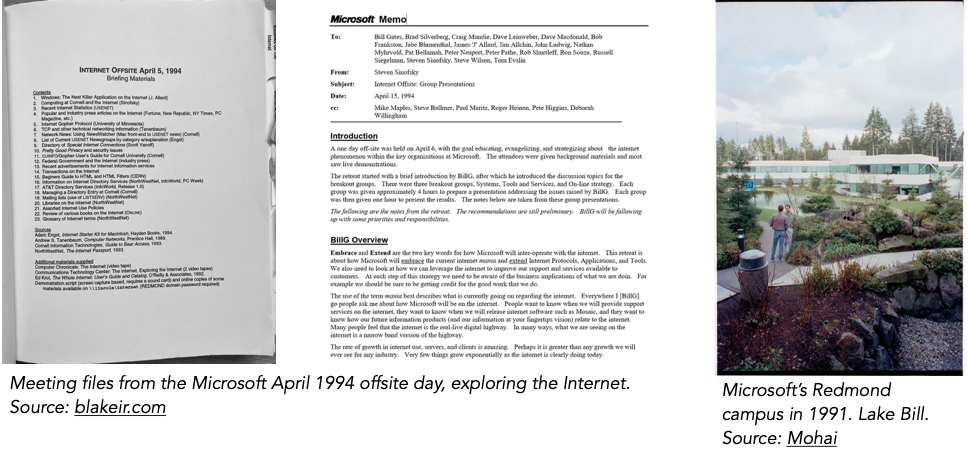
Microsoft had some spectacular failures, such as Microsoft Money, which resulted in a 1994 attempt to acquire Intuit for $1.5 billion. That said, there were also wins where Microsoft moved very aggressively, such as the browser war with the fast-emerging Netscape Navigator. Despite the fast internet growth, it was still unclear how companies would eventually monetise the internet, and the browser being the first point of entry to the internet seemed attractive, and to ensure victory here, Microsoft aggressively bundled the Internet Explorer with the very successful Windows 95 OS, free of charge to customers.
AOL would later acquire Netscape, but the aftermath of Microsoft’s aggressive business tactics led to the dark antitrust years, a period Bill Gates claimed distracted Microsoft and cost it the loss of the mobile revolution.
Steve Ballmer (2000 - 2014)
The Steve Ballmer years as CEO of Microsoft were often summed up as the dark Microsoft days, a 14-year period its share price declined by 33% and experienced costly failures such as missing out to both Apple and Google in mobile computing, missing out on the advertising-led internet business models to Meta Platforms (Microsoft attempted to buy Facebook) and Google and internal product failures with Windows Vista and the most financially costly mistake, its efforts with search via Bing.
During these 14 years, Microsoft grew its net profits by 6.3% annually, and while this might seem like a total failure, Microsoft began building the foundations for a more enterprise-centric company.
Oracle (2000)
Winning the enterprise customer
Contrary to popular thought, Microsoft wasn’t initially a dominant force in enterprise solutions as it is known today. In the early 1990s, to extend its solutions beyond operating software, Microsoft entered the relational database market, which helped businesses store and retrieve structured data more easily via a range of applications like Microsoft Access, Microsoft SQL and Microsoft FoxPro.
Oracle had long dominated this market after creating the first relational DBMS in 1979, but as more players began entering the market, they diversified into enterprise software, competing more directly with Microsoft. The bitter rivalry between the two companies would take a turn when Oracle’s founder, Larry Ellison, admitted to hiring private detectives to spy on Microsoft and Bill Gates.
More relevant to the investment case today is while brutal at times; in 2003, both companies competed directly for 94 contracts, Microsoft’s server operations and competition with Oracle pushed them into being more enterprise-oriented; understanding client needs, enterprise sales and tender processes, technology consulting (Microsoft founded a successful consulting JV with Accenture in 2000 - Avanade), improving its brand and corporate image and trust with major corporations, among others.
Steve Ballmer’s push in the server and tools market proved quite successful, and by 2007, it represented 22% of Microsoft’s revenue. More importantly, it prepared Microsoft for the next phase of computing, selling the cloud to enterprises.
Amazon Web Service (2008)
Willingness to self-disrupt
Today, Microsoft’s cloud computing division represents 38% of the group’s revenue, but years ago, it was a startup project within its server and tools division. Several technology companies had already begun investing in cloud solutions, particularly Amazon with its AWS Elastic Cloud solutions. The challenge many older software companies faced, like Microsoft, Oracle and VMware (later acquired by Broadcom), was that cloud computing cannibalised their existing operations, and Microsoft was among the few willing to self-disrupt quickly.
The Azure cloud platform saved customers the need to build their own data centres, and alternatively, rent compute and storage bandwidth from Microsoft on a pay-as-you-go basis. As we’ll discuss later, Amazon was more aggressive with scaling its cloud platform, particularly with startups and small businesses and has maintained its market-leading position in the cloud market since its inception. That said, Microsoft has stayed a durable number two, strategically leveraging its trust with larger corporations, including corporations like Boeing, Pixar and Toyota as initial customers.
Although the economics of cloud weren’t as attractive as Windows OS or Office, it kept Microsoft at the forefront of technology and also supported the broader transition of the rest of Microsoft’s businesses from the license model to the cloud subscription format.
Although several people were critical of Azure’s growth (code-named Red Dog), like Ray Ozzie, Mark Russinovich and Dave Cutler, Satya Nadella, then president of the broader Server and Tools division, was selected by Ballmer to lead Microsoft as its CEO.
Satya Nadella 1.0 (2014 - 2022)
Microsoft was no longer the only golden technology company and had to share technology leadership with new players like Alphabet and Meta Platforms, and to prepare for this era, Nadella made conscious efforts to broaden the corporate culture within the server and tools division, a market where it wasn’t the incumbent market leader, by focusing on win-win partnerships. Microsoft’s business relationships with rivals like Adobe, Samsung and Alphabet were rebuilt, avoiding costly litigation and also supporting industry peers building products for its broadened ecosystem.
Another key factor central to the investment case for Microsoft is customer stickiness and the transition from the license model to subscription, which, in hindsight, proved to be extremely beneficial for the group.
Case study: The license to the SaaS model transition
One of the ten categories of quality is the nature of demand, companies with products and services that are mission-critical, profit margin resilience during downturns, and recurring solutions. Microsoft had always been mission-critical, but the perpetual license of most of its services meant it lacked the other attributes, which made sales lumpier despite a minimal marginal cost to serve customers.
By 2008, Microsoft had already started exploring the subscription transition through Microsoft Exchange and Microsoft SharePoint, and by 2010, it launched Office 365, bringing the rest of its productivity tools to customers on a subscription basis, initially priced at $6 per user per month, in line with the Office pricing, assuming a 3- to 5-year replacement period.
On the cost side, the shift to SaaS required more investments in its data centres, compute and other delivery costs such as monitoring, security and marketing to reduce churn rates, leading to an initial profitability burden. As an organisation, Microsoft’s EBIT margins continuously declined from 39.8% in 2008 to 29.8% in 2016 (chart below), with operating profits growing by just 1.5% annually. Of course, the heavy investments required in delivering the Azure platform alongside hardware bets like the Nokia acquisition and the Microsoft Surface laptops partially contributed to the margin dip during this period.
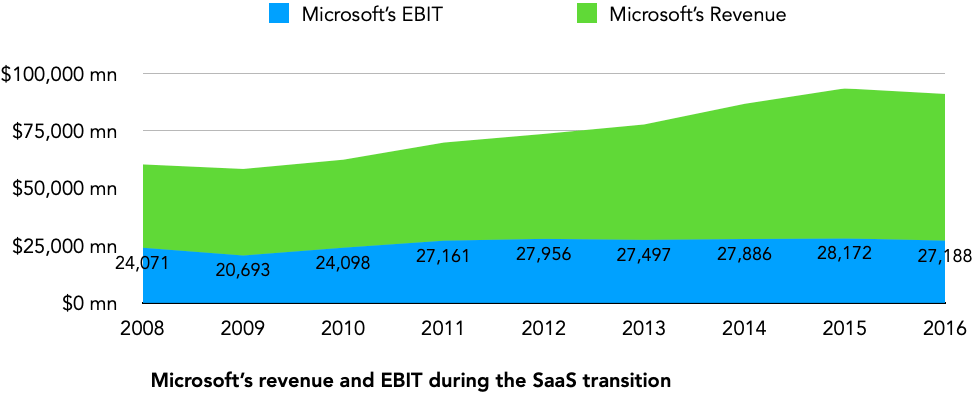
As time would prove, the transition to the SaaS model (operationally and culturally) proved highly beneficial and accretive to its prospects, particularly when compared to its 1970s peers like Oracle and SAP, given its faster and more decisive execution.
AWS competition (2014)
Letting go of some dogmas
Given the eventual success with the Azure cloud platform, one might think Microsoft always got its strategy right from day one, but they were actually forced to evolve from a platform-as-a-service model (PaaS) to a broadened Infrastructure-as-a-service (IaaS) model.
Microsoft had previously viewed open-source as a threat to Windows, with Ballmer going as far as calling Linux, the dominant operating system for cloud servers, a cancer. However, to dominate cloud economics, Microsoft needed to embrace open-source technologies, an approach AWS had fully embraced, supporting its client wins. By 2012, Microsoft began reversing past decisions, launching Linux Virtual Machines (VMs), and within five years, 40% of all VMs were running on Linux.
Previous foes like Oracle, SAP and Red Hat Enterprise also extended their tools and services to Azure, making Azure a full IaaS competitor to AWS. Other integrations like Xamarin and acquisitions like GitHub (2018), LinkedIn (2016), which forced Microsoft to open APIs at a massive scale, transitioned Microsoft to a more open-platform business model, preparing the group for the technology transition, positioning it for AI.
Satya Nadella 2.0 (2023 - present)
Artificial intelligence
Before OpenAI’s ChatGPT launch in November 2022, Satya Nadella had long voiced his optimism for AI, as early as 2015, but before this, Microsoft’s AI efforts and financial results were limited to Azure and gaming experiences like its Halo franchise. Several failed products like Cortana (voice assistant) and Zo (chatbot) showed Microsoft wasn’t a serious player in AI, but that changed in 2023 when Nadella reframed Microsoft as an AI-first company.
Today, the narrative on Microsoft’s valuation is its AI competitiveness relative to big tech peers and startups and given recent share price drawdowns, it’s clear that the market thinks negatively of Microsoft’s position. I’ll discuss this more broadly in this deep dive, but first, it’s important to mention Microsoft’s efforts so far:
Integrating AI to product portfolio: The highest ROI and accretive step in most technological transitions is adapting existing product suites for AI, and Microsoft has moved both too slow and too fast to the extent it’s had to remove AI integrations (Copilot) from its Office and Windows 11 products. After several iterations, it seems Microsoft has now consolidated all its efforts under the Copilot franchise, serving as a companion to existing users. Unlike Google, Microsoft hasn’t established its own LLM (Large Language Model) and, rather, has focused on SLMs and integrating LLMs from peers into its Copilot offerings. I will discuss the challenges of this strategy later on.
Azure: Azure and cloud computing services is natural beneficiary of AI because they increase demand for compute, storage and networking. Beyond the Azure infrastructure, Microsoft has added more models for its enterprise customers, integrated apps and agents (Microsoft Foundry, GitHub) for customers, and, when combined with its governance and compliance standards, it has narrowed the cloud gap to Amazon.
External investments: Externally, Microsoft has invested in other companies, with OpenAI being the most significant, now valued in excess of $100 billion. Microsoft itself was built on these partnerships (IBM), and to ensure its further tied to AI’s growth, it has extended beyond just service provision to equity investments. There are risks worth discussing here, and I will highlight them in sections 4 (Inside the Data Centre) and 7 (Risks and Challenges).
Beyond the cloud, Microsoft has less room for product monetisation from AI when compared to Meta, Alphabet, and Apple, and integrations and partnerships will be even more critical here. A key pillar of Nadella’s tenure has been repairing Microsoft’s image to the broader ecosystem, and I believe this will further support its growth opportunity.
Current state of Microsoft’s moat
In the wake of another technological shift (AI everything), it’s tempting to doubt once again Microsoft’s ability to remain relevant, and here, I believe mapping out the historical context as we have just done, studying past failures, lessons learned and assessing the results of past decisions is key to gaining clues on how the future might look. Some key competitive advantages for Microsoft in this shift include:
Distribution and bundling power: Although Microsoft’s AI strategy still seems somewhat scattered (it partially is), distribution and bundling, two competitive advantages that have become even more effective today than ten years ago, are key competitive advantages for Microsoft. We got to see how effective Microsoft’s bundling of Teams, its web conferencing app, with the rest of the Office offerings was in neutralising Zoom, its main competitor’s rise. There’s still lots of scope for further product bundling when the enterprise customer is taken into consideration, and I believe its existing distribution to 400 million+ users will prove valuable.
Azure’s switching costs: The transition to SaaS in the enterprise software market has effectively reduced its once impenetrable switching costs, but in the cloud, AI further complicates the challenges, time, costs and resources required with switching cloud providers or taking certain processes in-house. Although cloud computing is mainly on a pay-as-you-go basis, the switching costs in time and effort remain immense.
Balance sheet strength: During the current AI boom phase of excessive funding, having balance sheet strength might seem irrelevant but as we saw during the 2000s tech bubble, Apple and Microsoft’s survival versus the hundreds of startups like Netscape, balance sheet strength will always be a key source of competitive advantage and when coupled with capital allocators willing to combine technological optimism (Satya Nadella - CEO) with discipline (Amy Hood - CFO), I believe it shapes the long-term investment case.
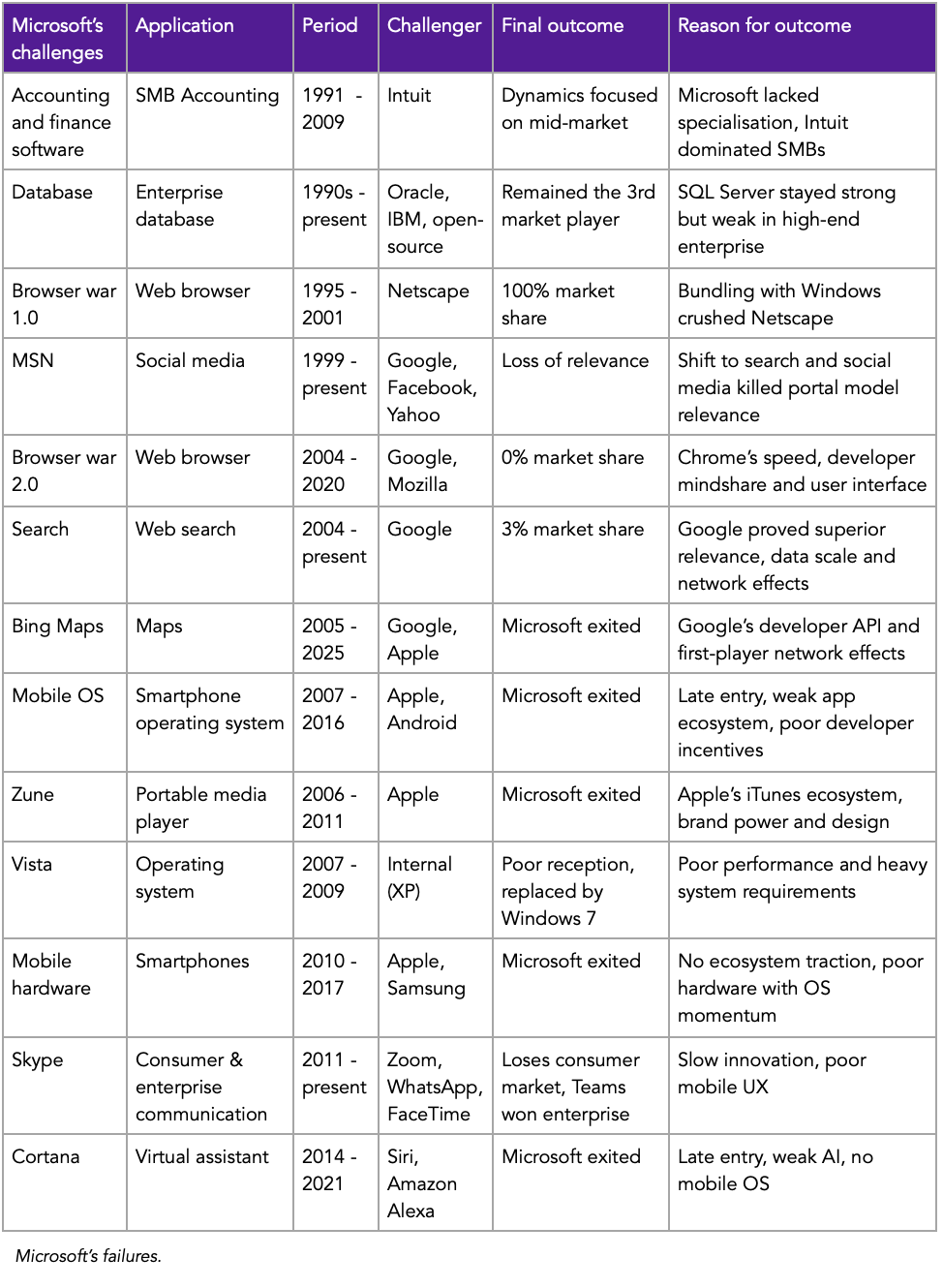
The table below highlights some Microsoft failures over the past decades. Despite these 13 big failures that cost them hundreds of billions in lost revenue, it’s impressive that Microsoft still manages to be a $300 billion+ revenue company, which highlights a final key point: its ultra-wide addressable market that keeps the growth potential huge.
2. Overview of Microsoft’s services
With Microsoft’s historical context now set, I will next introduce the products and services that make up Microsoft, discussing some learnings from my review of its various products. At a high level, I divide Microsoft into two parts: intelligent cloud (35% of revenue) and non-intelligent cloud (65% of revenue).
Microsoft’s non-intelligent cloud offerings (65% of revenue)
We can refer to this as the “traditional and acquisitions” segment of Microsoft. In today’s AI-driven world, the economics and growth prospects of this segment have taken a back seat among market commentators despite representing the larger share of Microsoft’s revenue and 65% of its operating profits. The non-intelligent cloud is split into three segments:
Enterprise Applications (Microsoft 365, Power BI, Dynamics 365)
OS and devices (Windows OS and Surface devices)
Consumer platforms (Gaming, Search and News Advertising and LinkedIn)
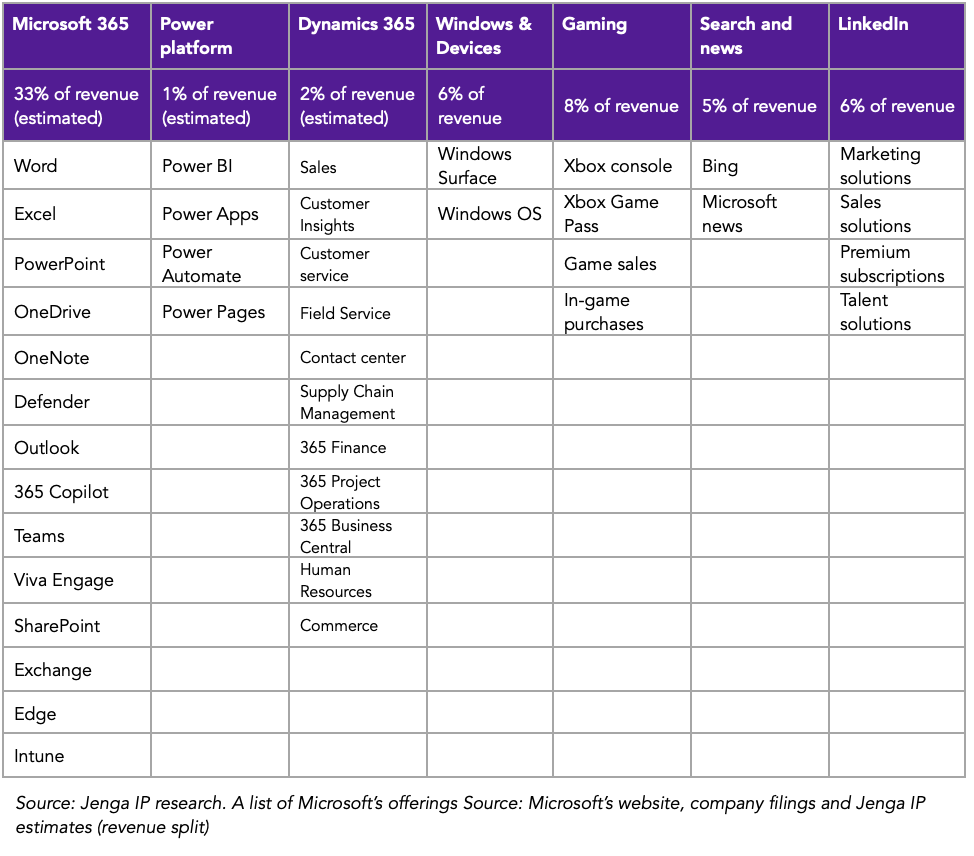
The table above maps out the core applications within each of these segments, and next, I’ll introduce the key products across these segments, starting with the largest, Microsoft 365 (commercial and consumer).
Microsoft 365
Microsoft’s 90%+ market share in operating software often took the limelight during the 1990s, but a lesser-known fact is that application software mattered just as much to Microsoft over the years, and while historically less profitable than operating software, it was less cyclical and more resilient to economic and technology industry shocks.
As the transition to the SaaS model opened a new growth engine with innovation and product bundling, the applications division has become significantly more important than OS. I estimate it is now nearly 6 times larger in revenue than OS, from roughly the same size during the 1990s and early 2000s. This is an important lesson on the benefits of diversification in technology and a platform-like business model.
Let’s next look at the three important application segments:
Core apps (Word, PowerPoint and Excel)
Backbone and control layer (Outlook, Exchange, SharePoint and OneDrive)
Interaction layer (Teams)
Core apps (Word, Excel and PowerPoint)
The three applications are central to Microsoft 365 and are utilised by over 500 million customers annually with Word (documents), Excel (spreadsheets), PowerPoint (presentations), each addressing the key workflow and productivity tools and while not officially provided by Microsoft, I estimate they contribute directly around half of Microsoft 365’s total revenue, or $42 billion annually, averaging an EBIT margin of around 73% (Jenga IP estimate).
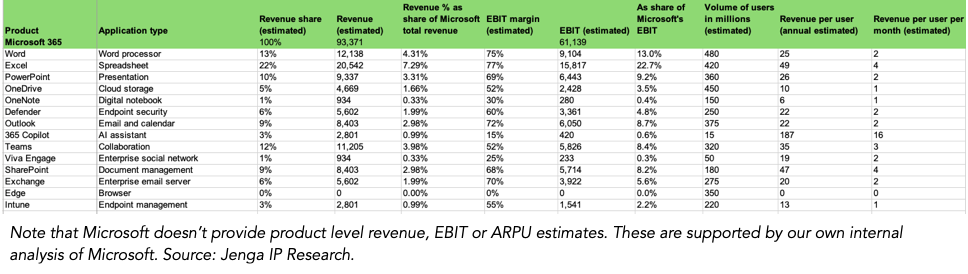
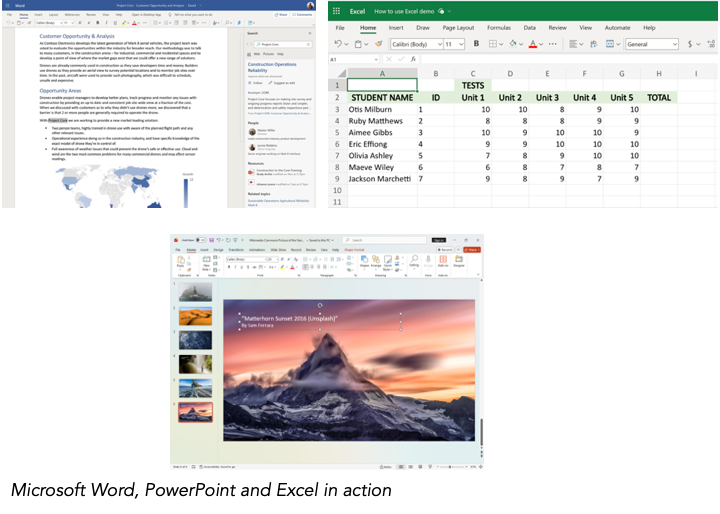
In the 1980s, Microsoft realised the potential value each of these markets could become and given the nature of its “winner-take-most” economics they responded quickly with creating the three applications over time, introduced file formats such as .doc for Word and .xls for Excel, increasing the switching costs to rival products built by Lotus 1-2-3 and then bundled each into the Microsoft Office product.
The Office 365 consumer plans are currently priced between $4.4 to $18.8 per user per month, while one-time Office 2024 currently retails for $180. When scored across 13 product metrics (recurring demand, Big Tech competition, benefits from bundling, market share), the three core apps score very favourably compared to the other 365 applications. You can see this from my colour-coded (0-10) table below.

While all three continue to dominate their productivity categories (see table below) and are used across all industries and customer groups, there’s some competition, led by Google’s Workspace, who have won customer end markets like startups and the education end-markets.