

The past month has created what I believe to be “attractive but not yet bargain” valuations for some very high quality companies. Numerically, what I mean here is that several companies that were once expensive in my view seem to now meet the minimum 15% IRR hurdle based on my analysis.
I’ll briefly discuss two recent ideas, and you can view this as a short note. I’ll save the investment cases for their respective deep dives.
Microsoft (Investment initiated)
The outperformance of big tech companies has long been covered by market commentators in recent years, but an unlikely fact is that the big tech company I believe to be the highest quality among the group, Microsoft, has actually underperformed the S&P 500 over the past 1, 3 and 5 years.
I maintain a list of 8 companies within my circle of competence that I’d willingly hold shares at 30x P/E. After concluding my research earlier today, I initiated a 6% position in Microsoft, paying 26x its trailing net earnings or 23x its 12-month forward earnings.
Although roughly in line with an expensive S&P 500 (25.8x), Microsoft is one of the handful of companies that deserve a substantial premium to markets (alongside recent new purchases like Visa and Mastercard).
Some risks with Microsoft keep me concerned; its growing dependence on OpenAI, increasing Capex intensity and its cloud market share loss to Alphabet. However, its more subscription-based business model relative to the more cyclical advertising revenue or hardware sales as with Apple or Tesla, keeps its business model more robust than its peers.
While I’ll save the Microsoft investment case analysis and valuation model for its deep dive once we complete the ongoing U.S. financials theme, I thought to share three big picture P/E facts:
Microsoft versus Apple - For the first time in 13 years (4th December 2012), Apple is valued on a forward P/E premium of 1/3 or more to Microsoft (31.8x versus 23.5x).
Microsoft versus Meta Platforms - 29th January 2026 was the first time in 7 years (25th July 2018) that Meta was valued at a premium to Microsoft.
Microsoft versus Alphabet - For the first time in 11 years (30th July 2014), Alphabet is valued on a forward P/E premium of 1/3 or more to Microsoft.
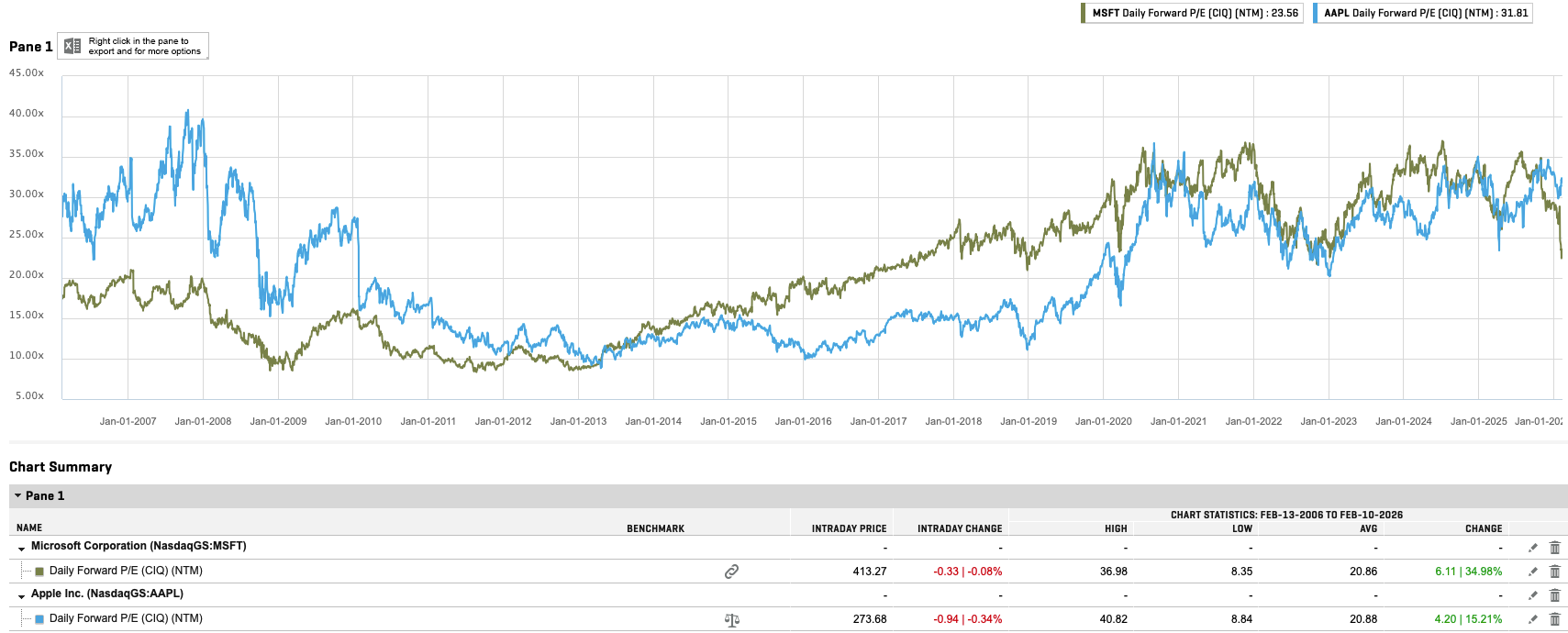
What these three facts mean is that it’s been a long time since Microsoft was valued at a discount to three of its four closest peers. Interestingly, Microsoft’s shares did go on to outperform each of the three companies in the following 3,4 and 5 years after they last hit these discounts 7 to 13 years ago.
That said, we are still far from the peak of Microsoft pessimism in 2011, when it was valued at 9x P/E. A reminder that there’s really no floor to market pessimism.
S&P Global (added to core watchlist)
FactSet’s biggest rival is S&P Global’s market intelligence division, particularly its Capital IQ platform. While I identified S&P Global as a higher quality company given its more diversified and mission-critical offerings across ratings, indices, financial and energy market data, I concluded the valuations for S&P Global weren’t yet attractive and thus opted for its competitor in my FactSet deep dive.
What I didn’t foresee was S&P Global’s shares falling by -23% year to date, with its forward P/E falling to a five-year low of 20.3x, a discount to the S&P 500. Although totally different in industry and products from Microsoft, the two companies are quite similar in business model and valuations.
Both are companies I regard as 30x P/E companies with high barriers to entry, diversified and recurring business streams with solutions entrenched and mission-critical to their customers and have also passed the test of time. Both have also underperformed the S&P 500 over the past 1,3 and 5 years and fell to 9x forward P/E during the troughs of negative market sentiment in the late 2000s.
At current valuations based on my earnings, buybacks and dividends estimates, S&P Global does currently meet my 15% IRR hurdle over the next five years. However, I haven’t included them in the portfolio due to my already large position in FactSet.
Should S&P Global’s shares continue falling and become a >20% IRR investment case, you can expect me to include them in the portfolio, regardless of the investment in FactSet.
Beyond these two, there are a few other companies I’ve transitioned to our watchlist but will leave nameless for now until I have a strong conviction on their quality and growth prospects.
Big Tech update
I also want to leave you with two Big Tech tables, one is from my Q2 2025 Big Tech earnings update (published 13th August 2025), and an updated table of the same companies based on today’s prices.
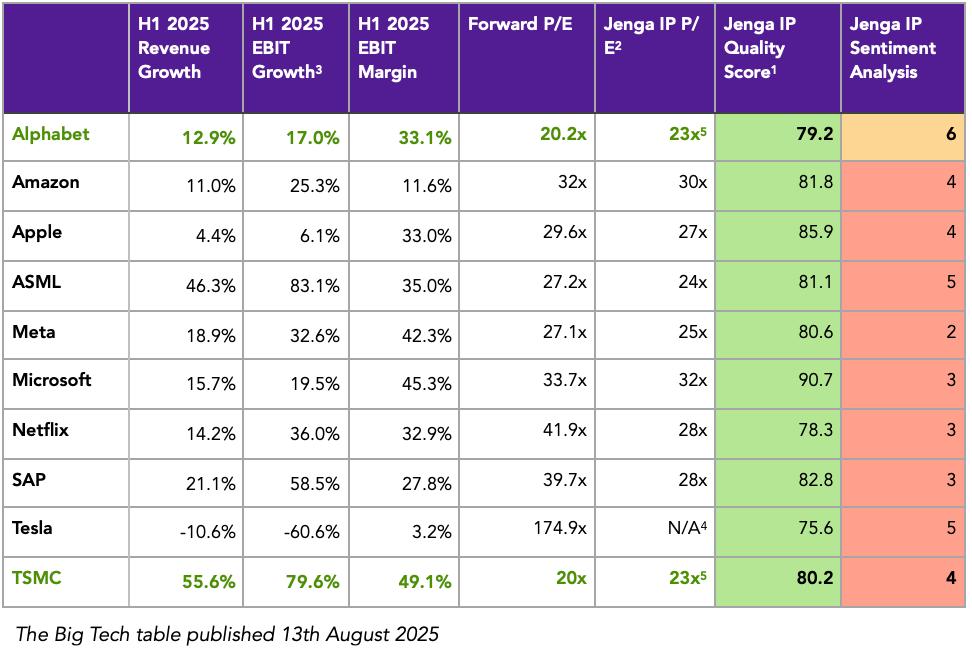
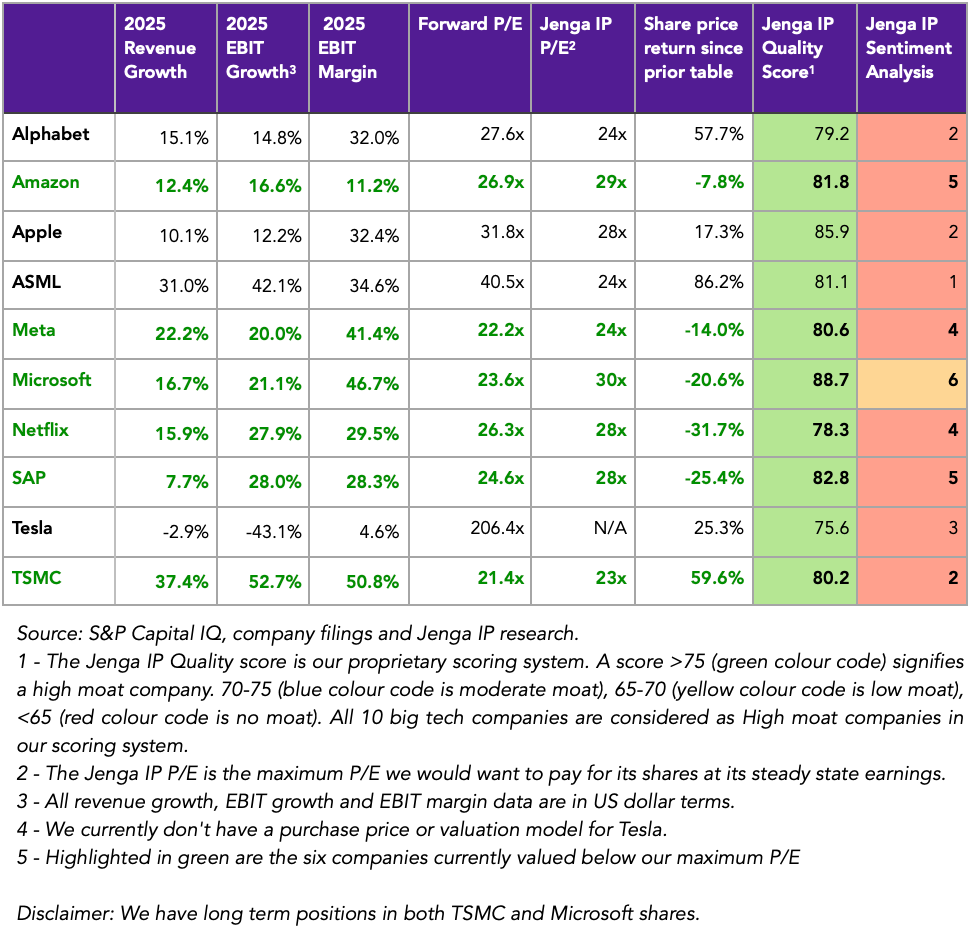
Some thoughts from the table:
Alphabet and TSMC: We had selected two of the three top performers, TSMC (+59.6%) and Alphabet (+57.7%) in my last Big Tech update. Both companies were the only companies below the Jenga IP purchase P/E multiple and were recommended from the list.
ASML: ASML, a company I missed out on, turned out to be the best performer, delivering an 86.2% share price gain in 6 months.
Amazon, Meta, Microsoft, Netflix, SAP and TSMC: Today, the Big Tech opportunity seems more dispersed as there are currently six companies (see table 2 highlighted in green) below the Jenga IP P/E multiple.
Downgrades: I downgraded the Jenga IP P/E multiples for Microsoft (32x to 30x), Meta (25x to 24x), and Amazon (30x to 29x) upon reflection on their business model, mainly driven by recent Capex intensity levels.
Upgrades: I upgraded the Jenga IP P/E multiples for Alphabet (23x to 24x) and Apple (27x to 28x), driven by increased growth prospects for both companies.
In line with my recent investment decision, Microsoft shows the greatest divergence between the Jenga IP P/E and the current forward P/E.
In the last week there was markdowns on some techie shares on the NYSE and much concerns raised due to impact of AI on business model of the companies. Software stocks have lost more than 20% of their value in 2026 — wiping out $1 trillion in market value while the S&P 500 has remained unchanged, according to AInvest. One can expect that there is still a long way to go on the fullness of AI disruptions. The impact curve is at its onset and it must remain in the surveillance radar for the immediate foreseeable future.