

Over the next couple of weeks, I’ll be sharing some earnings updates on industries I follow, starting with luxury, then big technology and transport infrastructure.
I’ll first share a general note on my thoughts and perspectives on investing in luxury today: quality, its cycle and current valuations. Then I’ll discuss their earnings (calls, presentation and commentary) centred on ten topics and then conclude by sharing what I’m hoping to see for the second half of the year and some investment thoughts.
My luxury story
The luxury industry, like semiconductors, insurance brokerage and transport infrastructure, is one of the industry ecosystems I'm long-term optimistic for as a public markets investor. I began investing in the luxury industry five years ago at the start of my global equities career, and in 2022/23, I sold out of three (L'Oréal, Ferrari, LVMH) and held onto one, Kering (now sold, but what a tragic investment mistake!)
My decision to sell was initially valuation-driven. L'Oréal, for example, was valued at 34x forward earnings earlier in 2023. Later on, I started noticing cracks in the Chinese luxury spending, which has now become a global phenomenon (excluding Japan? We'll discuss).
Over the past three years, after nearly 20 years of growth, the luxury industry is dealing with a bad downturn, and in Prada's CEO, Andrea Guerra’s words:
"Let me repeat, this is probably the worst downturn.” - Q2 2025 Prada Earnings call.
Many financial analysts, including myself, didn't foresee this decline or the disparity across the industry's brands and categories.
Quality in luxury
Today, I don't own any shares in the luxury space, although there are three companies I'm tracking closely (which I will discuss further later). That said, over the long term, I believe luxury offers investors four quality attributes;
Passed the test of time
Good profit margins at both the unit economics and company-wide level
Strong balance sheets
Better than average pricing power through the cycle.
On the flip side, luxury companies suffer from several issues. First, there is the nature of demand; there are so many Ferraris a customer could purchase annually or Gucci belts. The infrequency of purchases due to their discretionary nature makes apparel and leather goods more exposed to economic shocks than cosmetics, for example.
Another quality attribute that luxury companies fall short in is the value they create for society, which is more of a philosophical point. Compared to Microsoft or TSMC, luxury companies generally have much less value to society, limiting the scope for government and society support.
While certainly not as bad as tobacco or gambling, during tough economic periods, luxury could sometimes become an area of regulatory and political pressure, leading to unforeseen risks.
Note: See case study on when the U.S. government added additional tax to fur coats and jewellery priced above $10,000 in the early 1990s.
Q2 2025 earnings
Over the past few days, several luxury companies reported their H1 2025 earnings. In the table below, I highlight ten of the larger companies which I believe provide a more balanced picture of the luxury space compared to smaller-cap names. Note, while Estée Lauder and L'Oréal aren't "luxury", I include them as I believe it helps provide a more balanced perspective with apparel and the leather goods companies.
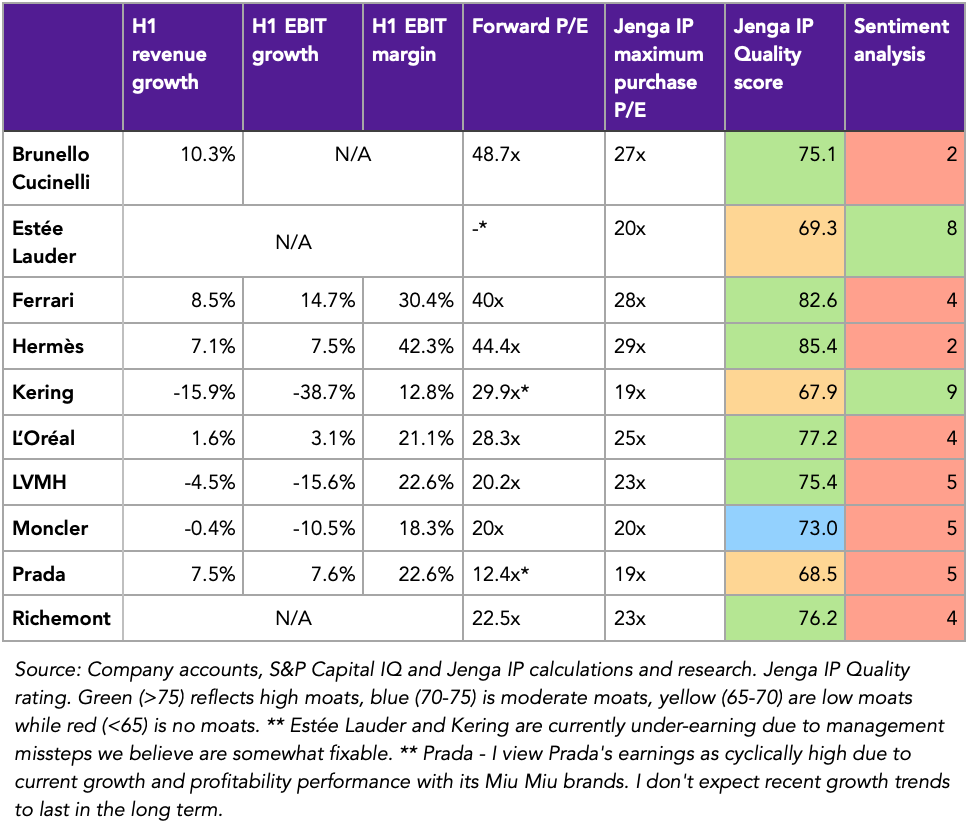
As the table portrays, the average across the seven companies that have reported their full H1 2025 earnings, so far have experienced a revenue growth of 0.6% in H1 2025 while their EBIT declined by 4.6%, with EBIT margins averaging at 24.3%, which is still marginally above the ten-year average of these seven companies (23.9%), indicating there might be further room for EBIT declines in H2 2025.
The declines were led by LVMH and Kering, with the latter, Kering, alongside Estée Lauder, currently experiencing deeper fundamental issues.
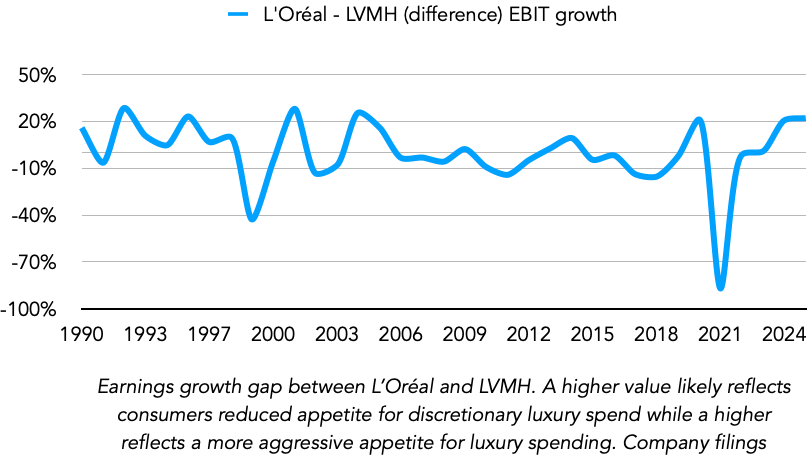
One key metric I often assess to get a sense of the luxury cycle is the EBIT growth gap between the discretionary bellwether (LVMH) and the staples bellwether (L'Oréal). The current EBIT gap of 18.7% in H1 2025 (L'Oréal grew its EBIT by 3.1% versus LVMH's EBIT decline of -15.6%), or assessing from a trailing 12 months lens, 22% EBIT gap, is the most significant disparity since the early 2000s (chart below), a period the global economy was in a recession which in my view, reflects just how bad the current state of the luxury market is.
If I were to group these ten companies across their current fundamentals, I would have four categories: fantastic brands, quality experiencing cyclical shocks, successful turnarounds and underperformers (see table below)

A challenge with investing in luxury (excluding Hermès and Brunello Cucinelli) is that any brand could be in any category depending on your timeframe. For example, over the past 10 years, Kering has transitioned across all four categories, so it's essential to know what is "priced" into its shares.
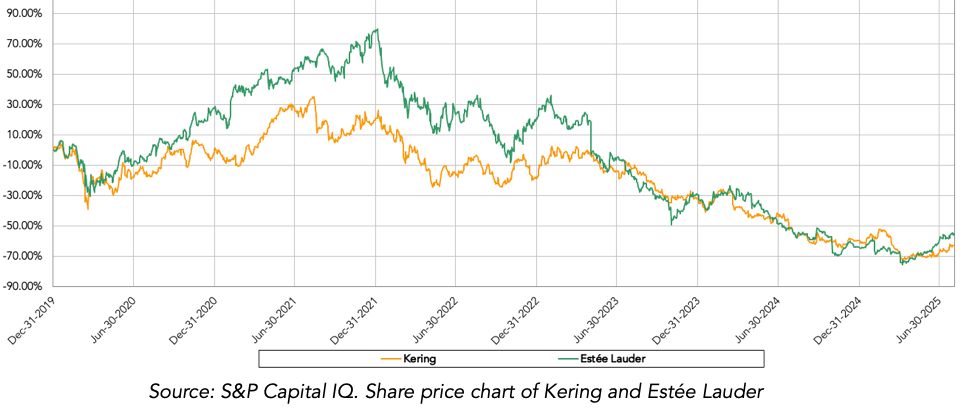
An underperformer priced as a fantastic brand (Estée Lauder 40x P/E or Kering's 35x P/E in 2019) will lead to abysmal share price performance; Kering’s -63% and Estée Lauder’s -56% share price return since 2019, see the chart below.
This leads to the next section, where I'll further analyse the H1 2025 earnings reports and calls across ten key topics:
Further performance disparity in H1 2025
Problems at LVMH?
The Japanese market
The Chinese market
US tariffs and currency volatility
Store closures
Current state of pricing power
Innovations in luxury
M&A update
Capex cycle
Further performance disparity in H1 2025
There continues to be a disparity across luxury; by geography, across brands and more recently, by category. It seems categories like accessories are now performing worse than leather goods for most companies. Hermès CEO, Axel Dumas, provided some insights on this trend as their leather goods division grew +12% compared to the watches segment decline of -8% in H1 2025.
“We have divisions with a bit more volume like belts, jewels and accessories, which have been affected a bit more by the drop in footfall… There is quite a gap between these categories” - Axel Dumas, Hermès CEO.
He went on to provide further commentary on this during the call:
“I can tell you that the clients who discover Hermès, who step into the store for the first time and often their first purchase will be a belt or a perfume or silk, these people are slightly less numerous at the moment because across the whole world, there is a lot of concern about geopolitical and economic developments.” - Axel Dumas, Hermès CEO.
If we go back to Hermès H1 2023 results, a period both watches (+24%) and accessories (+35%) outperformed leather goods (+21%), H1 2025 is certainly quite different, which, in my view, reflects the tightening budgets for the entry-level luxury consumer.
For more diversified groups like LVMH, the disparity is even more glaring. Wine and spirits declined by 7%, but within this category, cognac & spirits (-15% decline) performed much worse than champagne & wines (-2% decline). Management flagged uncertainties related to tariffs for cognac, but I wonder if the problems for LVMH are far worse than just category declines?
Problems at LVMH?
During H1 2025, LVMH revenue declined by 4.5% while its EBIT declined by 15.6%, and from my count, this is the sixth time in the last seven semi-annual reporting periods LVMH has missed earnings forecasts. This is certainly unusual for LVMH, and the gap between both Hermès and LVMH continues to widen.
At an EBIT level, LVMH has historically grown 3-5% slower than Hermès; between 2010 and 2022, Hermès' net profits grew at 18.9% CAGR versus LVMH's 14.1% CAGR. However, over the past three years, LVMH's EBIT declined by -3.2% per year versus Hermès' 15.4% CAGR, reflecting an 18% earnings gap.
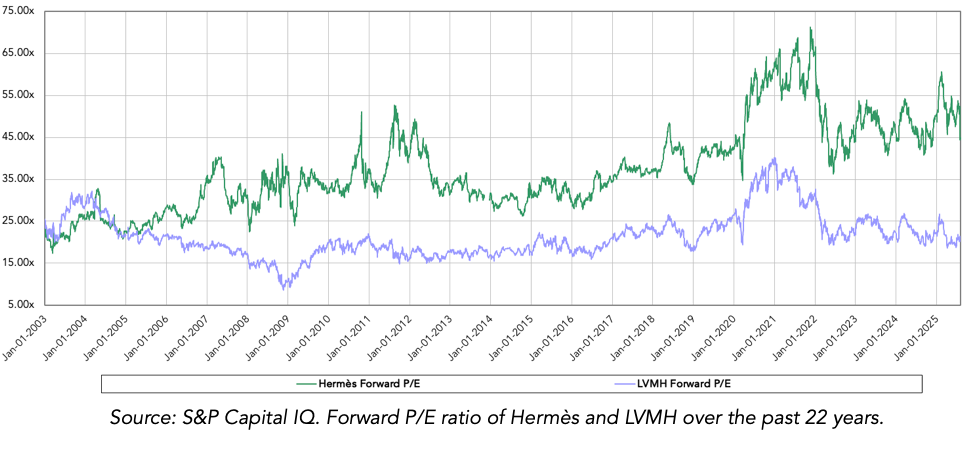
On a forward earnings level, the gap between Hermès and LVMH is even wider, 44x versus 20x, well above the long-term median of a 13x multiples difference, suggesting investors continue to see a larger performance gap between Hermès. The question here is whether this is a flight to quality in Hermès or problems at LVMH?
In my view, it's a bit of both. The LVMH earnings call sounded a bit more defensive and less optimistic than previous calls. It's CFO, Cecile Cabanis, highlighted some bright spots for LVMH;
On quiet luxury - “You mentioned Brunello Cucinelli. We have the fastest-growing quiet luxury brand in the group.” A reference to its Loro Piana brand.
On Vuitton performance - “We don’t see a distortion in the Maison performance. What we see is really the distortion which is driven by Asia and the overall macro around Asia and currencies.”
On fashion & leather goods - “We continue to have a very high margin at 34.7%, which is a great result given the deceleration in sales.” Note, this is twice as high as Kering's margins.
The Financial Times shared some investigative pieces highlighting bigger issues at LVMH's wine and spirits division, which I believe is worth a read: workforce job cuts, aggressive pricing and employment scandals. Reuters and Business of Fashion also investigated Louis Vuitton Texas factory, which reportedly faces labour issues and high defective bags output.
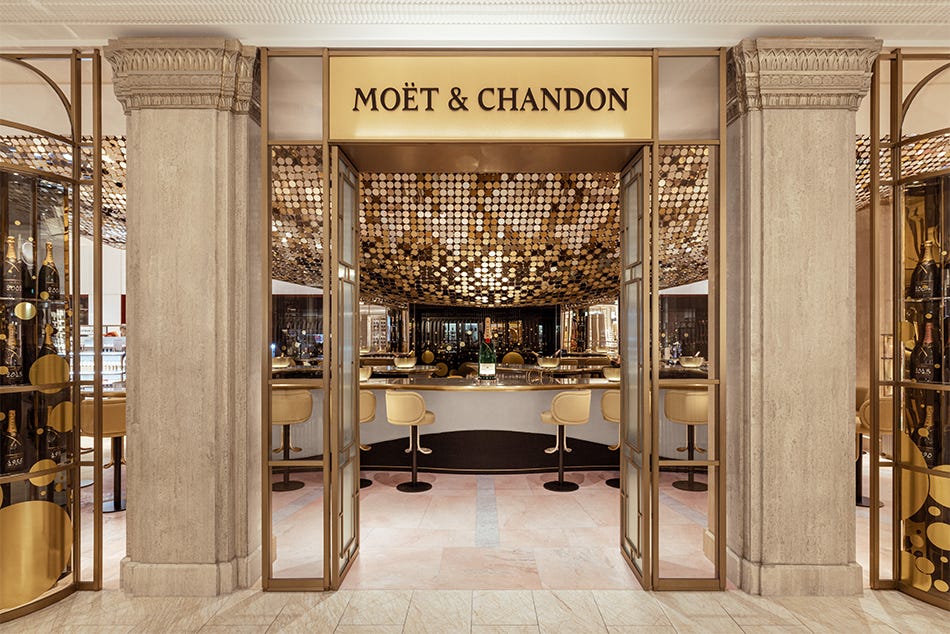
Concluding on LVMH's overall position requires further investigation, but I wouldn't recommend simply ignoring these. LVMH has built a reputation over the years as a near-flawless organisation, so any culture or product-level issues, no matter how small, are worth some concern.
The Japanese market
The Japanese Yen depreciation that started in late 2021 reminded the luxury industry of the importance of the forgotten Japanese luxury market. In my Kings On The Catwalk book reflections and summary, I discussed just how important Japan was for the luxury market in the 1980s, a period when Japan was nearly 50% of the global luxury industry.
Hermès CEO Axel Dumas reechoed the Japanese importance during their H1 2025 earnings call:
“Japan is a country where Hermès has a very long-standing story… Half of the time, I saw my uncle [Jean-Louis Dumas, former Hermès CEO] leaving for Japan…. Japan is a country where we’ve always invested… I think one of our strengths at a time when people divested in Japan [1990s]…. We continued to invest in Japan.”
The cheaper Yen led to strong tourism in Japan for 2022 and 2023, with companies like Richemont (+25%) and Prada (+31%) reporting outstanding growth in 2024. In Kering’s woeful 2024 result, Japan was the only growth market among its four major regions, growing 9% compared to Asia’s decline of 24%.
The Japanese recovery, however, seems to have run its last legs, particularly in Q2 2025, as all companies are broadly reporting weaker tourism spending given the improved pricing gap comps. Chinese tourists had flocked to Japan to take advantage of its weaker currency and cheaper prices.
Kering provided some colour on Chinese spending patterns:
“In the quarter, about 1/4 of spending by Chinese customers took place outside of their home market and close to 80% of their overseas spending remain in Asia, including Japan.” Armelle Polo, CFO, Kering
Moncler, which doesn’t usually split out its Asia revenue, provided the following commentary by its Director of Investor Relations, Elena Mariani.
“One thing that we can say that is helpful is that the other parts of Asia were not negative. So it was the only country that was negative, Japan.”
“The currency evolution that we have seen is the Yen going up, Renminbi going down. The price gap was existing till the end of 2024 and was not relevant enough to push Chinese to come and buy luxury goods, at least not Moncler during the quarter.”
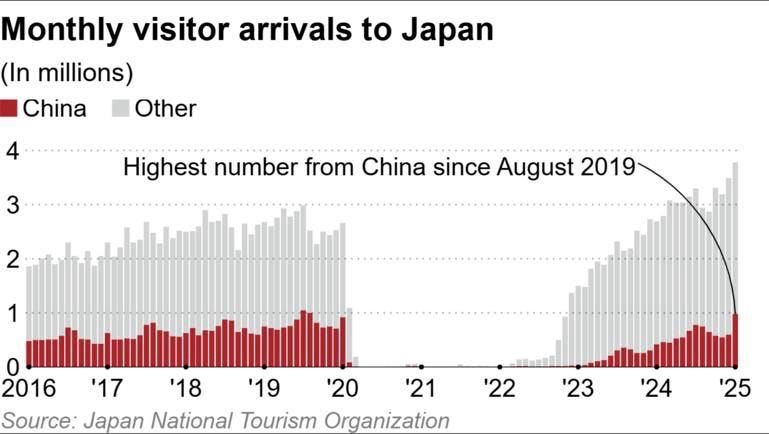
In my view, given that it's clear that the Chinese customers are a key driver for Japanese luxury, it’s important not to look at both markets in isolation and consider both, examining Asia as a whole.
The Chinese market
The performance in China varied across brands and categories, with cosmetics companies like L'Oréal reporting an unexpected return to growth, after 5 quarters of declining performance, but still at a slower pace than the rest of its group on a like-for-like basis.
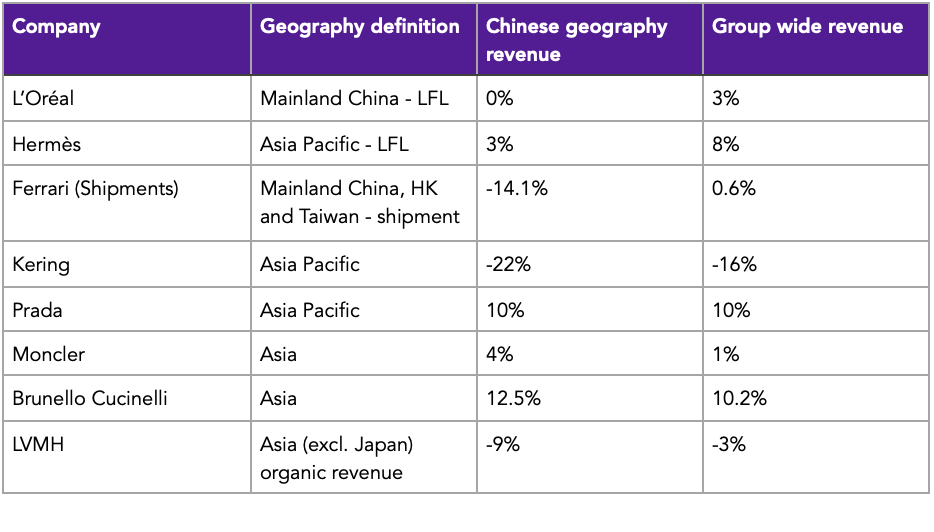
In the table above, I highlight China's geographical region and compare its growth to the respective group-wide revenue for each of the eight companies that have reported revenue data for H1 2025. Among these seven, Brunello Cucinelli and Moncler were the only two that saw faster growth in Asia (China is estimated to be 80-90% of Asia Pacific demand).
Across all luxury items, down jackets, a market Moncler specialises in, is a rare bright spot for the Chinese market, with Chinese domestic peers similarly reporting some growth.
Note: At Jenga IP, I own shares of one of Moncler’s rivals, Bosideng, the volumes leader in the Chinese down jacket market.
On the other hand, Brunello Cucinelli's above-average Asia (and thus Chinese) growth is a reflection of its more controlled expansion in the region. Today, Asia is 28.6% of Brunello Cucinelli's revenue, compared to the 35-45% common across larger luxury peers, and its management noted that the double-digit growth performance here is a reflection of its superior discipline to peers.
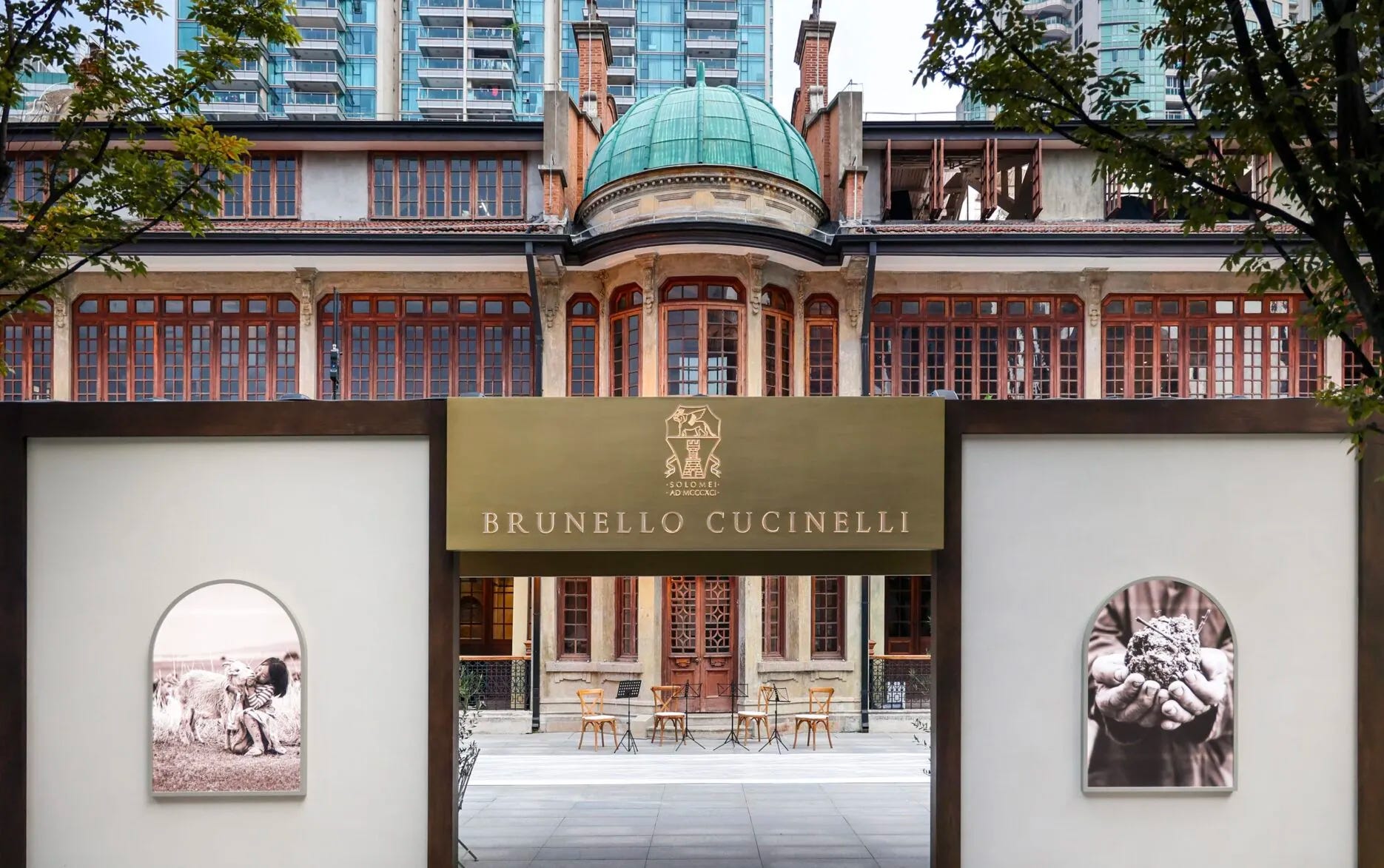
To deal with the struggling Chinese market, Kering seems to be more focused on better controlling its wholesale market and closing down underperforming Chinese stores. On the other hand, Hermès announced it will be opening new stores in Shenzhen and Guangzhou in H2 2025.
The Chinese market no doubt continues to be challenged, although to a smaller extent compared to last year. The better-run companies are clearly those taking advantage of the downturn in a more controlled manner (L'Oréal, Hermès, etc).
US tariffs and depreciation
Suppose one needed another reminder on just how globalised the luxury market is, one just needs to assess the impact of the US tariff and currency depreciation on the industry's performance. Among all the various risks and challenges highlighted, the US tariff volatility was the most discussed subject across all earnings calls I listened to.
“On one side, devaluation, on the other side, geopolitical, is now turning to the fact that there is less American tourists in Europe.” - Andrea Guerra, CEO, Prada.
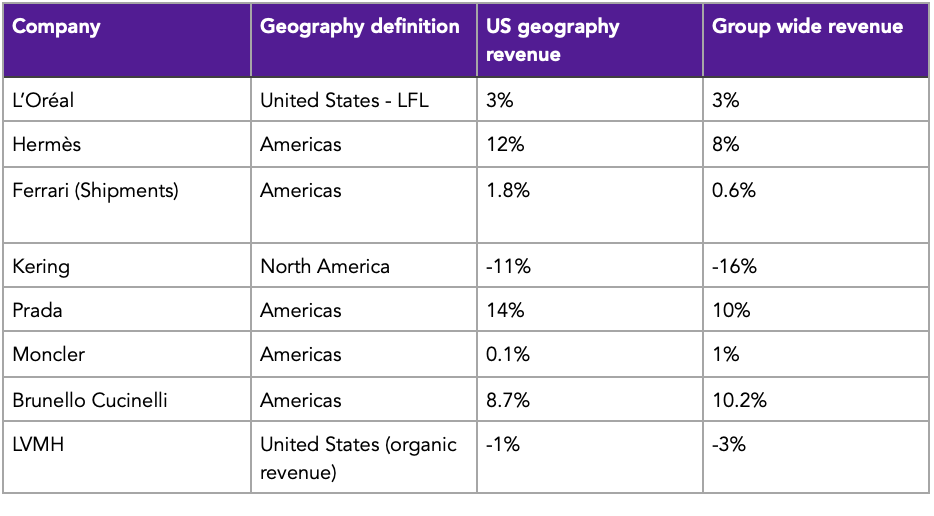
The US continues to play a key role in luxury. In the table above, most companies, excluding Moncler and Brunello Cucinelli, performed better in the US than their group-level revenue growth, highlighting how well the industry navigated the challenging period.
Some, like Hermès, quickly passed on the currency devaluation to customers (because they can);
"The negative impact of currency was offset by price increase in May in the U.S." - Eric du Halgouët, CFO, Hermès.
“Harder” luxury brands focused on ensuring they had enough existing inventory in the US to minimise impacts from the tariffs;
“We were not impacted by the incremental tariff in the U.S. as we leverage the inventory already present in the country.” - Antonio Piccon, CFO, Ferrari.
While most noted that the American local spending is broadly unchanged, there has been a sharp deceleration in American tourism:
“But tourism decelerated for Americas because you know that we started the year with the U.S dollar at EUR 1.04 and we are now at EUR 1.17.” - Cecile Cabanis, CFO, LVMH.
From a currency standpoint, I invest in US dollars, and while its depreciation improves my spending here in London, from an investment portfolio level, I'm less concerned about the currency swings because these companies are balanced geographically, limiting the impact of any one region over the other. The bigger worry is really on the brand-specific challenges, leading to the next point, store challenges.
Store closures
Whenever industries move towards a downturn, it's common for management to tilt more towards efficiency and productivity, and the luxury industry has been no different. For some years, I rarely heard questions regarding store productivity during earnings calls, but in the first half of the year, store productivity was discussed by management for some time as they shared their strategy here.
There are three things one can do with stores: open more, close down or remodel/enlarge. The best luxury companies are cautious and meticulous with their store growth model; Hermès today has only 230 stores (193 managed directly) globally and opened only five stores in H1 2025, while closing six stores, resulting in one net store closure.
Across the companies, it's very clear that there's a bigger focus on very productive real estate and store positioning, with an emphasis on prime luxury locations. Prada, for example, flagged the reopening of its New Bond Street boutique in the UK and its Men's store on 5th Avenue, the U.S.
Another focus is on increasing the square meters of existing performing stores, rather than opening new stores.
“Americans are showing us their love on Miu Miu. So we had to increase some square meters, probably in the region between 10 and 12%. In 2025. We are still in the region of the 170 stores.” - Andrea Guerra, Prada CEO
Brands in the underperforming category are even more aggressive with store closures. Kering, for example, reported -41 net store closures with a target of 80 net closures for the year, with its Capex dedicated to stores declining by 41.9% between H1 2024 and 2025. For Kering, its store closures are particularly aggressive within the Asia Pacific (China), representing 24 of all store closures.
It will be interesting to see how this focus on store efficiency could impact margins when the cycle turns more positively, especially at those more aggressive on store productivity like Kering. For others, like Brunello Cucinelli, who maintained a more disciplined store expansion model, I don't expect much impact on margins.
State of pricing power
Looking back on my internal notes on luxury, one of the key points I made is its pricing power, a key feature of quality. Among the ten companies, they average a pricing power score of 7.8 out of 10, led by Ferrari (9.75/10) and Hermès (8.65/10).
However, this pricing power was overextended by the industry, and it's clear that the industry is employing various strategies to address the pricing challenges, given the worsened state of the consumer.
Moncler's Chief Business Strategist, Roberto Eggs, reflected on why Moncler has managed to outperform in this economic climate:
“You know that we have been increasing prices over these past 3 years to a much lesser extent than the peers of the industry. The idea was always to protect our margin and just reflect the increase we have had in terms of raw material and production costs…. Clearly, the pricing today for consumer is a concern”
Simply cutting or discounting prices is a mistake; another luxury brand, Burberry, learned the hard way. To circumvent this challenge, more challenged brands are using innovation as a tool to reduce product prices, with the (re)launch of lower prestige products in new seasons.
Here, Kering's management highlighted that the Gucci Giglio and similar new products launched in its Gucci Cruise collection are at more reasonable pricing points. While I haven't examined this yet in its bags collection, I have however, noticed a slight drop in prices for scarves and some accessories. I will certainly investigate this more.
Some companies like Brunello Cucinelli directly addressed how they are approaching price increases:
“Well, as far as the prices are concerned, our prices have grown 3%, 3.2%, 3.5% worldwide. Tariffs will have an impact on the second part of the year, plus 4% only in America” - Brunello Cucinelli, Chairman.
LVMH broadly commented on pricing and mentioned that to justify price increases, it needs to invest more in innovation, product quality and functionality.
“For us, pricing is very clear. It needs to come with an improvement in the product, whether it’s quality or adding functionality.” - Cecile Cabanis, CFO, LVMH.
As an analyst here, price reductions are indeed a bad signal, but the bigger lesson here is that price increases don't necessarily bring a long-term good signal, especially with a lack of product or service innovation. One needs to be more careful and read between the lines of ‘luxury price increases’ with context.
8. Innovations
One of the reasons I place Ferrari's pricing power higher than Hermès and LVMH is its capacity for innovation-led pricing power. The engineering and design capacity allows Ferrari to justify price increases on products better, leaving its overall pricing power far more sustainable when compared to apparel or cosmetics.
In this world with geopolitics and consumer tension, companies highlighted the various innovations with products and how they are investing more in their capacity here:
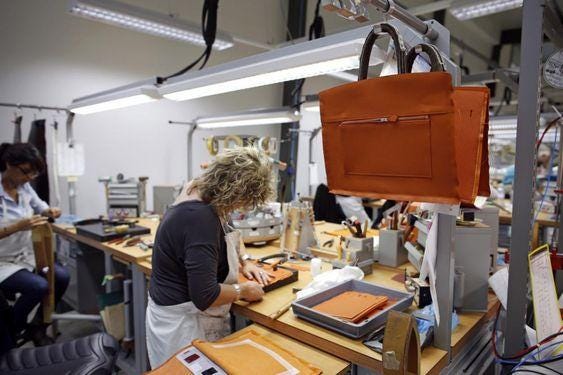
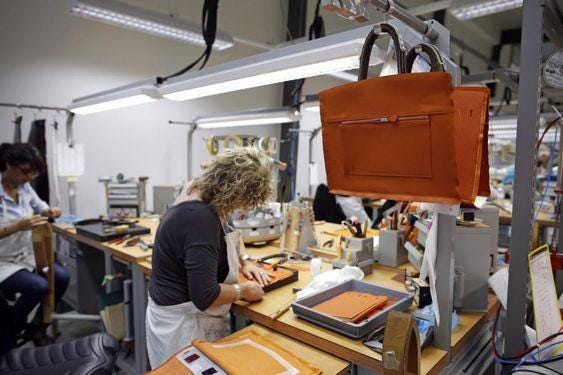
Hermès: Adding more workshops to increase craftsmanship capacity with four workshops over the next 4 years, starting with L'Isle- d'Espagnac in Charente in September. Hermès has 23 workshops with 13 opened since 2010.
Ferrari: Hybrid cars already make up 45% of Ferrari's shipments, but its first electric vehicle, Ferrari Elettrica, is planned for an October 2025 launch. Last month, Ferrari also revealed its 11th model of 15 models shared in its 2022 Capital Markets Day, the Ferrari Amalfi.
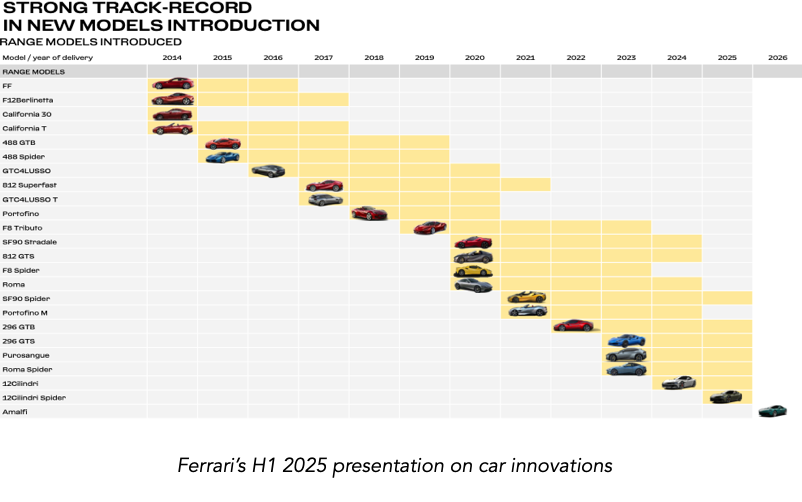
Kering: The share of "newness" in the product catalogue has become a key metric that management now communicates to investors. As of 2025, newsness stood at 55% of Gucci's portfolio ahead of the arrival of its next creative director, Demna Gvasalia.
There isn't a clear quantitative lens to measure innovation here. R&D as a percentage of revenue would be silly. However, from an analyst's view, I will certainly be spending more time assessing how customers view the innovations and functionality, particularly across the new product launches.
9. An M&A update
M&A has certainly slowed down across the industry, and the H1 2025 period was a particularly quiet period for M&A discussions. Among the major companies, only L'Oréal and Prada discussed deals during the period.
Prada expects its Versace acquisition from Capri Holdings, at an enterprise value of EUR 1.25 billion, to close in Q4 2025, but provided minimal commentary on its hopes and plans for the brand.
"Versace is not our company. And therefore, it's very unusual to give comments on other people companies" - Andrea Guerra, CEO of Prada.
L'Oréal announced two acquisitions: a majority stake in Medik8, a premium skincare brand and Color Wow, a US prestige haircare brand. In the H1 2025 presentation image below, management flagged where both brands sit relative to the rest of their portfolio from a pricing and health/glamour lens (see below).
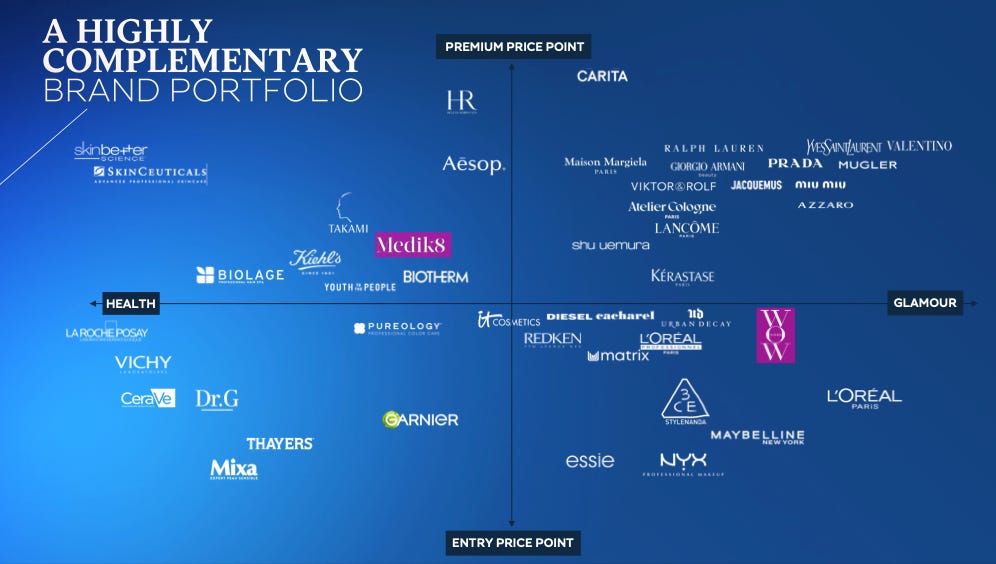
I'm less excited about both companies' acquisitions as I'm more biased towards organic-driven growth stories in luxury, which I find more sustainable over the long term.
That said, for L'Oréal, it seems there's been a slight shift in its philosophy, which I believe is due to how social media and influencers have changed the global cosmetics market. Here's what its CEO had to say;
“I think there’s a bit of a new name of the game, this idea that you would consistently support a pillar brand forever is a bit of the past”
Nicolas Hieronimus further mentioned:
“You have, of course, to keep supporting your catalogue. But when you have a fast-flying engine rocket, you have to instantly put more fuel in to potentialise it in the maximum way. So it will be, as always, at L’Oréal all about real-time management, flexibility and when we can add, we will add”
I interpret it as an admission that social media has eroded traditional moats in the cosmetics industry, and it's far better to capitalise on brands with a bit more traction with customers.
On one hand, this is good for diversified players like L'Oréal, but on the other hand, it shows just how challenging a single-product cosmetics strategy is. It will be interesting to see Estée Lauder's perspective on this topic in cosmetics, given its more premium and less diversified strategy.
10. Capex cycle
How does one respond to the luxury downturn? Cut Capex.
Well, not everyone. In the table below, I highlight the Capex and revenue changes for the seven companies reported to date, and as you see, all but Prada and Moncler saw their Capex decline or grow more slowly than revenue in H1 2025.
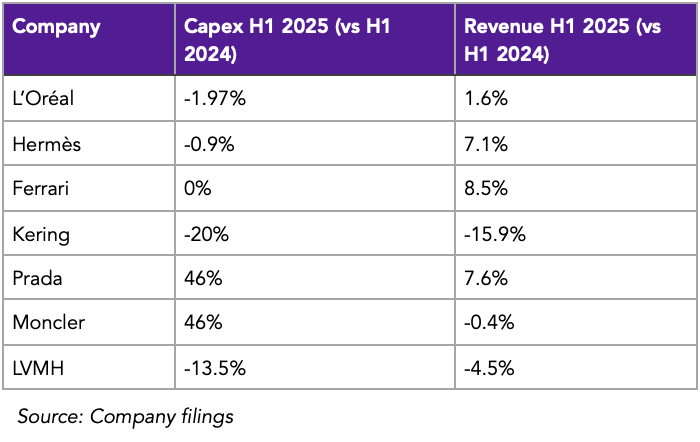
For Kering, its Capex has accelerated significantly in the past four years, so I view these changes as positive, reflecting its efforts to improve its balance sheet and be more disciplined.
For Moncler, I was a bit surprised by its 46% growth in Capex, but looking more broadly, its Capex isn't that elevated when compared to historical levels.
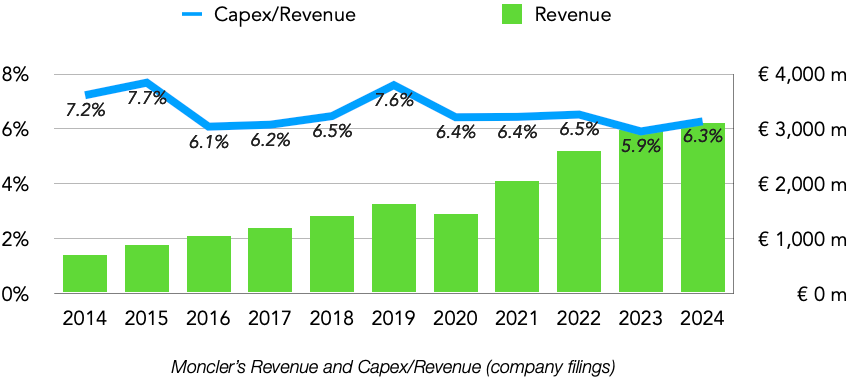
For 2025, management highlighted that Capex will be closer to 7% but expects to return to 6% in 2026 after it completes its new corporate headquarters and some other projects.
After reading several Big Technology earnings calls, it's refreshing to see another ecosystem with a slightly different Capex story, a reflection of the luxury downturn challenges.
Jenga IP’s position and concluding thoughts
At the moment, I don't have any investments in Western luxury brands, just Bosideng, a Chinese down jackets player and rival to Moncler and Canada Goose.
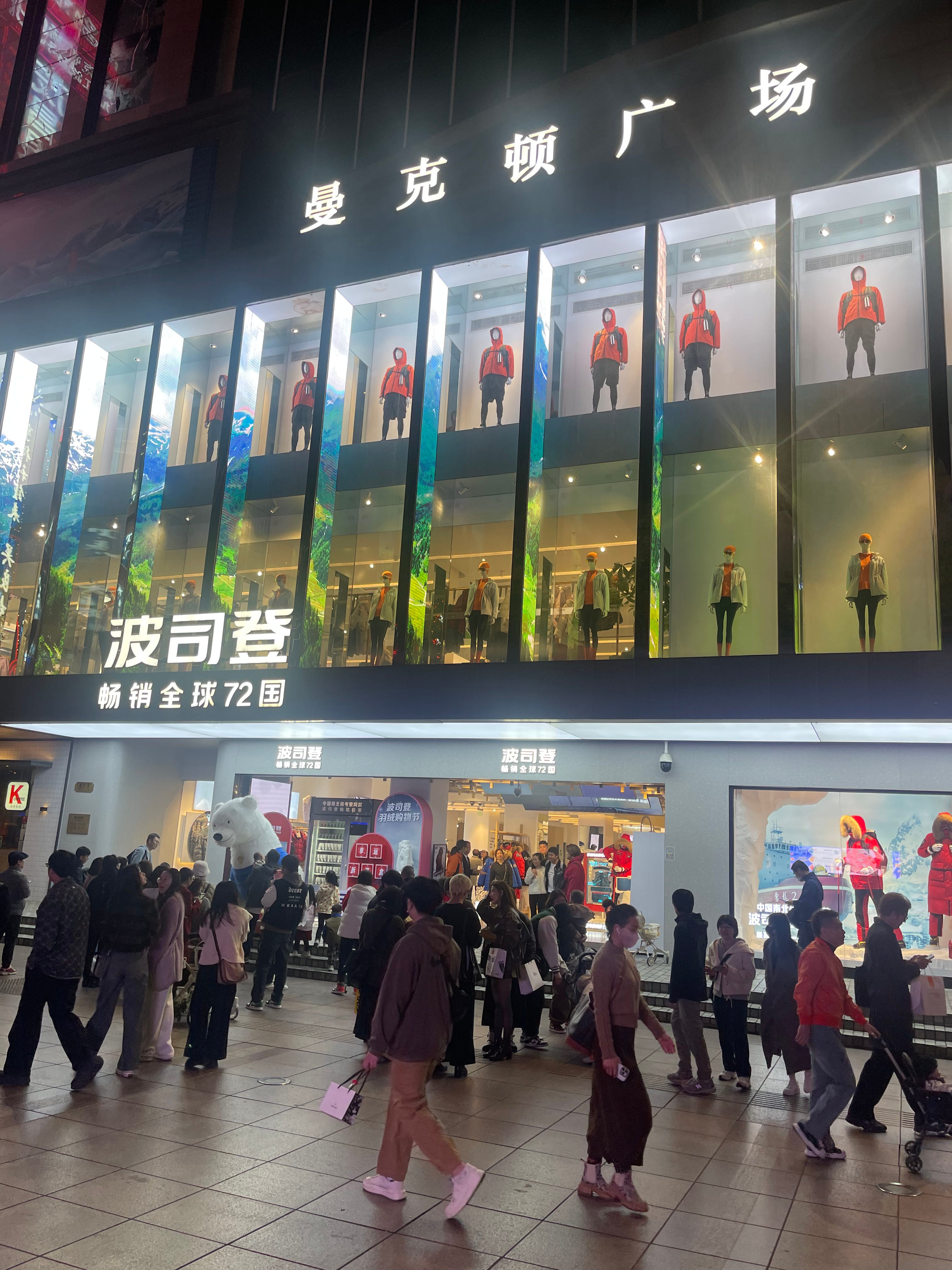
Source: Me! A Bosideng store during my last investment trip to Shanghai, China.
There are a few reasons for my very limited position in luxury despite recent share price declines.
The high quality companies I'd love to invest in are too expensive in my view, e.g. Hermès, Brunello Cucinelli, and Ferrari. Paying 40x for a company growing less than 20% per year tends to lead to poor outcomes.
I’ve learned to be patient when investing through cyclical downturns. Luxury tends to mirror the broader economy and with minimal scope for innovation-led fundamentals surprises, unlike in technology, I’d rather wait for things to improve first.
Compared to the previous economic crisis, the luxury industry still trades at an elevated earnings multiple. During the financial crisis, LVMH, for example, fell to a trough forward P/E of 8.5x, more than twice its current forward P/E of 20x. Note, its earnings decline in its most recent 2 years have been much worse than the 13% net profit decline experienced in 2009 (-17% in 2024)
That said, the role and potential of the Chinese economy make the luxury industry different from previous times, and I'm still convinced of its long-term potential. I recently transitioned Moncler, LVMH and Estée Lauder to our core watch list.
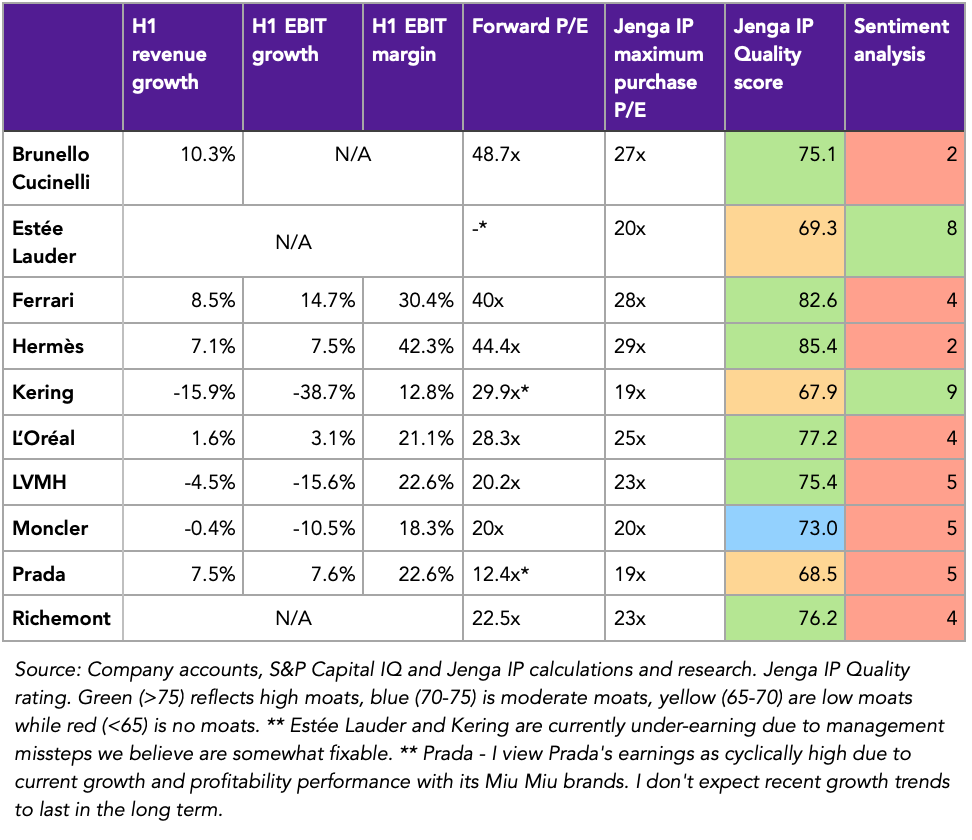
LVMH: As an upper limit, I'm willing to pay 23x LVMH shares, higher than its current 20x earnings. This, however, depends on the actual state of LVMH's brands and internal culture. I plan on prioritising further research here.
Moncler: While I view its premium to Bosideng's 12x earnings, Moncler is no doubt the best in class in down jackets and its global customer base provides more resilience to any downturns in the Chinese down jackets market.
Estée Lauder: The cosmetics group still trades at 19x its pre-COVID earnings, before it declined into its turnaround status, which isn't low enough for a potentially damaged group. I'll be closely monitoring its earnings update, scheduled for the 20th of August, to assess its recovery progress.
May I know why do you think Chinese wine industry has better chance to recover?