

You can access the PDF of the Jenga IP Quarterly letter here.
The Jenga Global Master Fund returned 8.10% in Q3 2026, versus the benchmark (MSCI World Index) return of 1.88%. The Fund outperformed its benchmark by 6.22% during the quarter, bringing the YTD 2026 return to 4.49%, versus the benchmark’s 11.75%.
Portfolio Update
Exits
There were no exits during Q3 2026.
Post-quarter Exits
Bosideng and Luzhou Laojiao (Chinese consumer) - After Q3 2026 and in line with the strategy of fully exiting Chinese investments, as discussed in the Q2 2026 Investor Letter, the Fund exited its remaining positions in both companies. A commentary review will be provided in the Q4 2026 Investor Letter.
New purchases
Adobe (U.S. software) - We initiated a 5% position in the global leader in creative, document and digital marketing software. Our research into Adobe showed that several tools such as Photoshop, Illustrator, Acrobat, Experience Manager and Real-time CDP, among others, remain the go-to tools for millions of premium subscribers. While AI-native tools would take some share from Adobe, we believe its increasingly bundled and integrated solutions would remain valuable to enterprises and SME users.
Adobe maintains strong economics (30%+ EBIT margins), and we believe its fortress balance sheet and strong free cash flow generation should support investments in AI defensibility and share buybacks. We purchased Adobe’s shares at 12x trailing or 9x market consensus forward P/E and see a potential 25% IRR over the next 4-5 years, supported by:
7% net profits CAGR
8% annualised contribution from share count reduction
Multiple revaluation from 12x to 19x P/E
You can read our investment deep dive into Adobe here or the summarised version here.
OMA and ASUR (Mexican airports) - We added to the existing investments in two Mexican airports, OMA and ASUR, paying 13x their market consensus forward P/E. We believe the recent share price drawdown driven by the Mexican peso strength, higher jet fuel prices and weakness in tourist demand for ASUR’s Cancún airport created favourable valuations, and we remain cautiously optimistic on the investment potential for both companies.
You can read our updated investment analysis of the Mexican airports here.
Post-quarter additions
S&P Global (U.S. financials) - After Q3 2026, the Fund initiated a position in S&P Global, the global leader in credit ratings and market indices. We paid 23x its trailing or 21x market consensus forward P/E. A full deep dive of our research into S&P Global will be published during Q4 2026.
Industry and country exposure
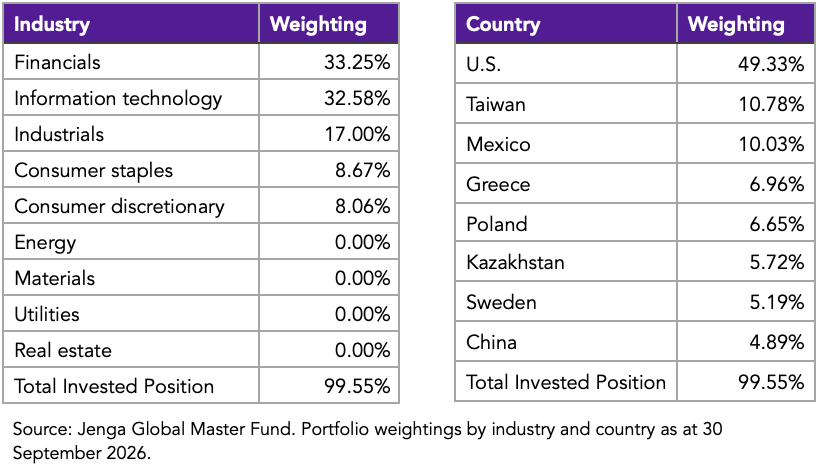
We concentrate on researching and investing in a few high quality companies that are undervalued relative to our analysis of intrinsic value. As presented in the industry and country weighting table above, our portfolio weights in Financials (23.2% to 33.3%) and the U.S. (18.2% to 49.3%) have increased since the start of the year.
Although our U.S. exposure remains below the MSCI World Index’s 72.3% weighting, we are materially overweight Financials, with a portfolio weighting more than double the MSCI World Index’s 15.7% weighting. Including the Q4 addition of S&P Global, and Intuit, a tax and accounting software company classified as information technology but, at its core, a provider of financial services, the projected weighting to financials is 45.3%. We recognise the concentration seems materially high, at first glance.
However, deeper research into the financials risk exposure as presented in the table below shows that most of the financials exposure, excluding Kaspi and, to a smaller extent, Farmer Mac, has limited financials risk exposure.
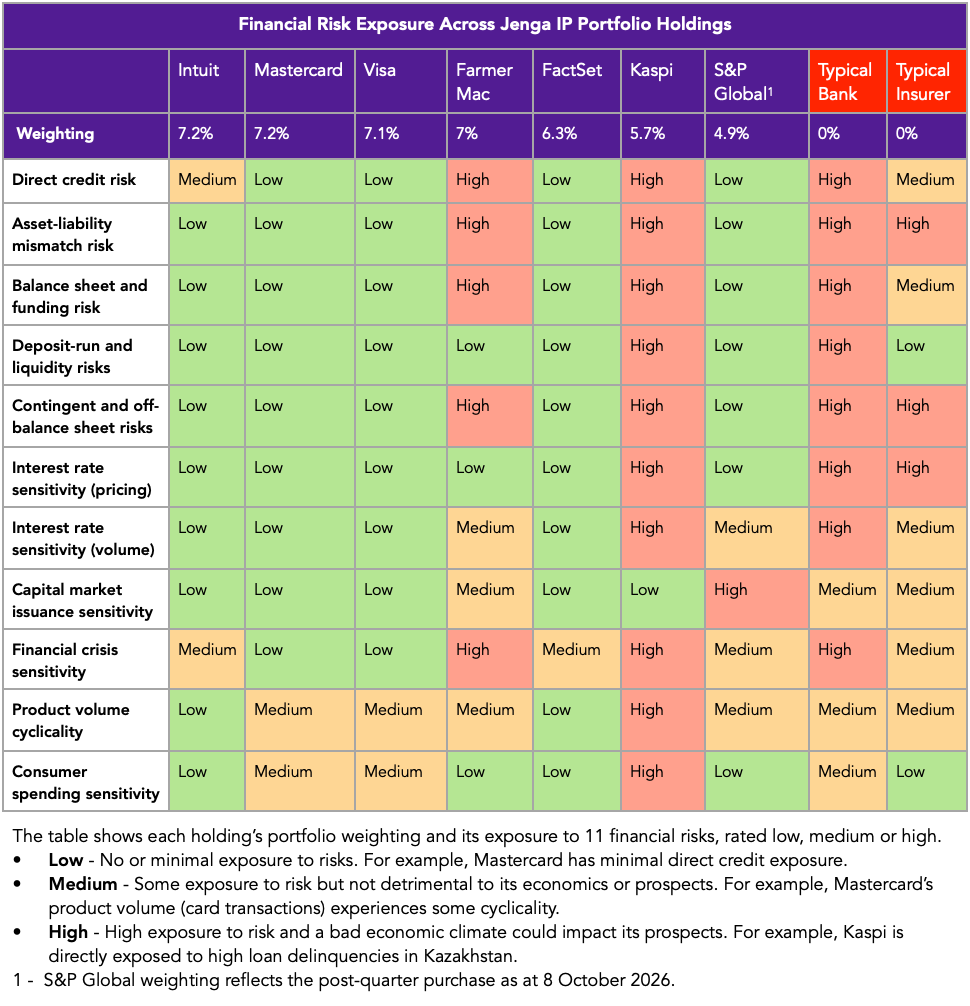
Financials such as banks and insurers face more material risks (see table above) than those faced by many other business models, and we must account for additional risks such as volume and pricing sensitivity to interest rates, asset-liability mismatch, credit and deposit-run exposure, among others. The table above highlights 11 of these financials-specific risks, and we carefully ensure we underwrite the inherent risks across our financials holdings.
Visa and Mastercard: We initiated positions at the two payment networks in Q4 2025 and Q1 2026, and we preferred both over peers such as American Express and Capital One because they have limited exposure to credit, balance sheet and asset-liability mismatch risks. During a financial crisis or volatile macroeconomic environment, we expect both companies to maintain high margins, albeit with card volume slowdowns.
Intuit and FactSet: Both provide financial services to SMEs and consumers (Intuit) and large asset and wealth managers (FactSet). Both companies have proved to be resilient during challenging macroeconomic environments, maintaining high margins with growing or stable market share. The main risk for both is their exposure to AI disruptions, and we are constantly evaluating their prospects. FactSet experienced a mild revenue growth acceleration to mid-to-high single digits in recent quarters, while Intuit currently expects mid-teens earnings per share growth for the coming years. Their sticky recurring subscriptions and mid-to-high switching costs limit their exposure to business model risks common in typical financials.
S&P Global: S&P Global has two significant financial risks: bond issuance slowdown impacting the transaction portion of its ratings division and a market drawdown impacting its indices division. However, at its worst, during the financial crisis, S&P Global still remained a highly profitable company and has recovered quickly during past downturns. Unlike banks, S&P Global doesn’t have significant off-balance sheet risks (potential liabilities on credit rating failures have proven to be limited), doesn’t face a deposit run or credit risk, or asset-liability mismatch risks.
Farmer Mac (Semi-bank): Farmer Mac (7% portfolio weighting), a U.S. GSE that supports the farm and rural utilities sector, has most financials business model risks but not all, such as high interest rate sensitivity and deposit-run risks. Rather than relying on customer deposits, Farmer Mac funds itself primarily through the issuance of GSE debt securities. It uses the maturity structure of its debt, callable funding and derivatives such as interest rate swaps to manage asset-liability risks. Its duration gap (how well the interest rate risk of assets and funding is matched) is 3 months compared to 4 years at the typical U.S. bank.
To account for Farmer Mac’s financials business model risks, we paid 9x P/E for its shares and have an exit valuation well below average market multiples.
Kaspi (A bank): Kaspi (5.7% portfolio weighting) is our holding akin to a traditional bank with all financials business model risks present. 61% of its assets are loans, 43% of its revenue comes from interest income, and we monitor metrics such as delinquencies and Kazakhstan’s macroeconomic and political environment. We account for these risks in our valuation. Kaspi is currently valued at 7x trailing and forward P/E, and we also have an exit valuation well below average market multiples and that of Farmer Mac.
Summarising the analysis above, while the quarter-end financials represented 33.3% of the portfolio, we consider traditional financial risks to be concentrated mainly in Farmer Mac and Kaspi, which together represented 12.7% of the portfolio at quarter-end.
This brings us to the full portfolio weighting in the table on the next page.
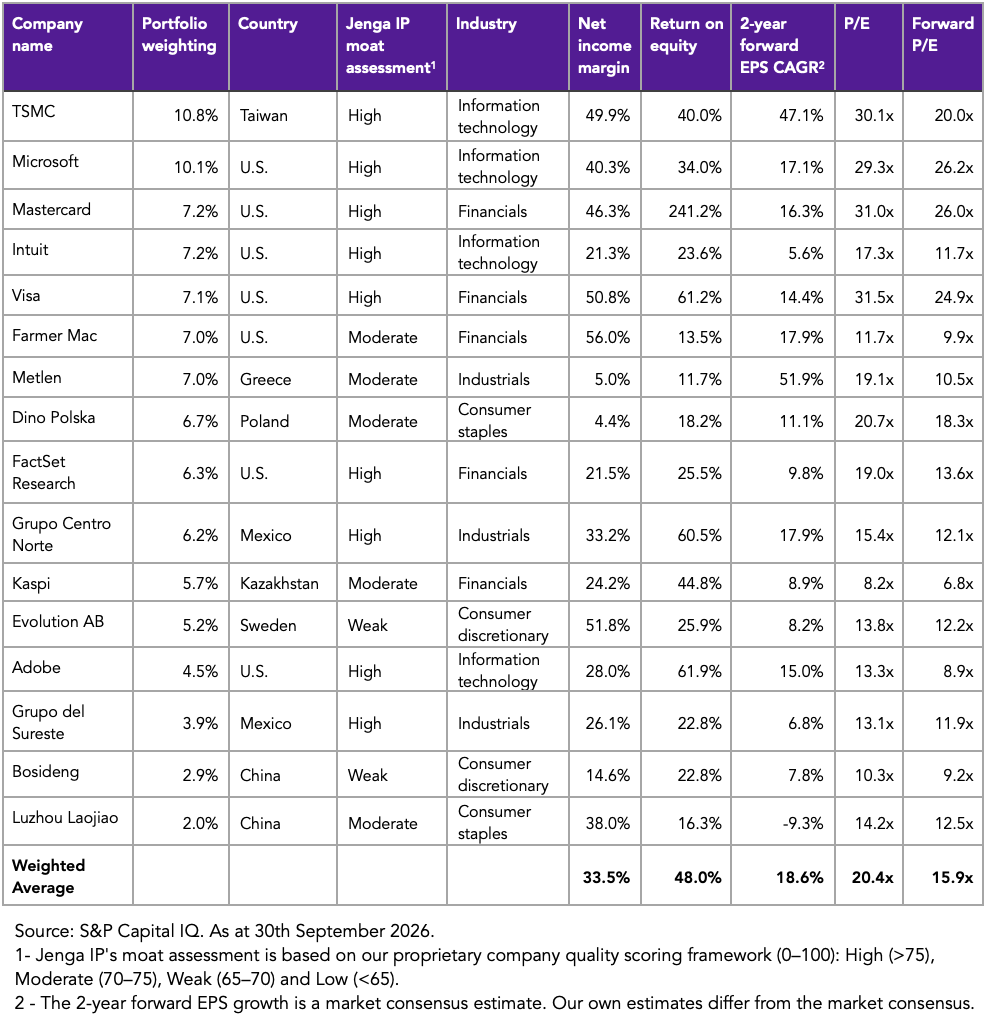
At quarter-end, the portfolio had a weighted-average net income margin of 33.5%, return on equity of 48.0% and two-year forward EPS growth of 18.6%, supported by market expectations for Metlen’s earnings recovery and TSMC’s chip manufacturing outlook. The weighted portfolio P/E increased from 18.3x to 20.4x during the quarter, driven by the share price appreciation in Microsoft, Dino Polska and FactSet.
The top detractors during the quarter were ASUR, OMA and Luzhou Laojiao. As discussed earlier, we took advantage of the drawdown and added to OMA and ASUR, while Luzhou Laojiao was fully exited after the quarter, in line with our strategy of exiting China.
Q3 2026 Investor Call
We invite you to join our quarterly investor call, where we will discuss our portfolio performance, recent investment activity and outlook, followed by a Q&A session.
Thursday, 22 October 2026 | 5:00–6:00 pm BST