

TSMC’s shares have doubled since I published my investment case deep dive last June, surpassing my 2029 estimated share price and IRR target. Despite this, I remain long TSMC and have since updated my valuation model.
In this article, I’ll walk you through the rationale behind the changes I made to its revenue, earnings and free cash flow estimates for the next five years, alongside an updated valuation spreadsheet behind the paywall.
TSMC has historically been, and remains, a cyclical company with long-term secular growth through the semiconductor cycle. I reviewed earnings calls over the past several years, and the table below highlights the 13 times management provided forward revenue or profit guidance, and as shown below, they’ve been historically conservative, only failing to meet their guidance on two occasions in the last 15 years.
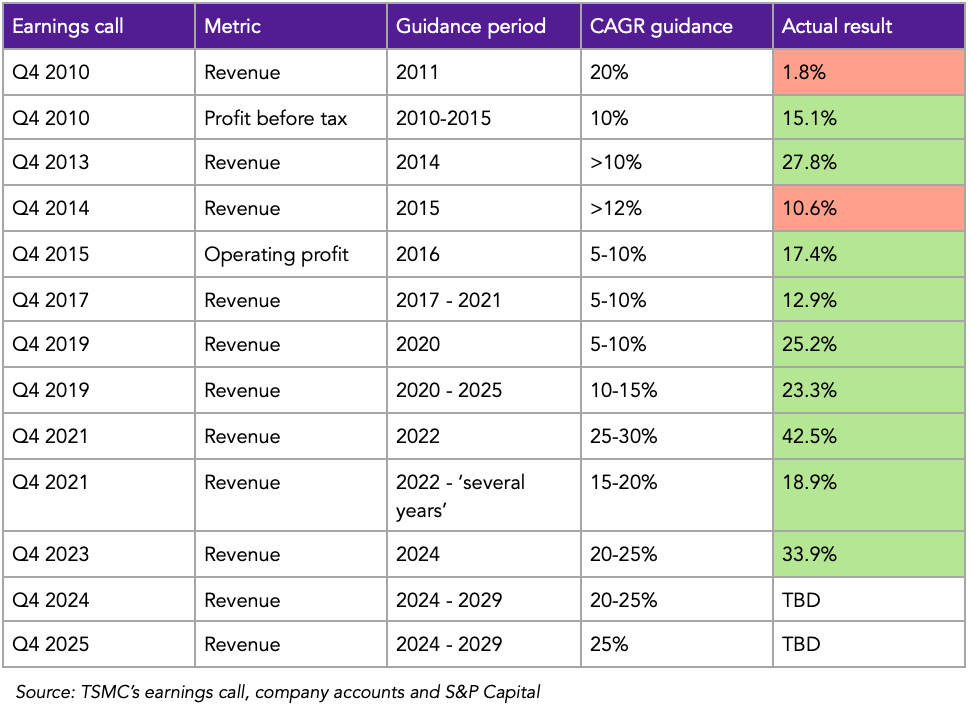
TSMC’s long-term growth target increased from 10 to 15% CAGR between 2020 and 2025 to 25% CAGR between 2024 and 2029, and the key growth driver is the ongoing AI boom, a theme I discussed during my initial deep dive but certainly underappreciated when I reflect on their customers’ updated growth ambitions, like Nvidia and Broadcom and their customers’ customer, such as Microsoft and Alphabet.
Like all contract manufacturers, TSMC responds to its customers’ demand, rather than creating demand, and by ensuring it has the most cost-effective and cutting-edge technologies available to customers, it can maintain market share and unit economics lead over rivals. There have been some updates since the TSMC deep dive, and I’ll discuss some of these across four topics.
The foundry market
There are different ways of calculating the global foundry market, and the two main methodologies I focus on are TSMC’s own reported foundry 2.0 market, which combines global foundry production and the advanced packaging industry, and the more direct revenue approach, comparing the revenue figures across the six largest publicly listed foundries.
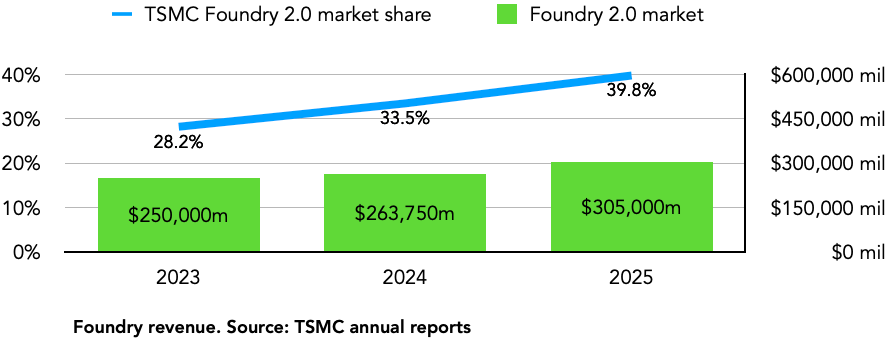
TSMC reported the foundry 2.0 market reached $305 billion, growing by 16%, less than half of TSMC’s own 37% 2025 revenue growth. It’s quite astonishing for a market leader to achieve this, and 2025 was another year TSMC maintained a 15 percentage point growth gap to the foundry 2.0 market and now represents just under 40% of the whole market.
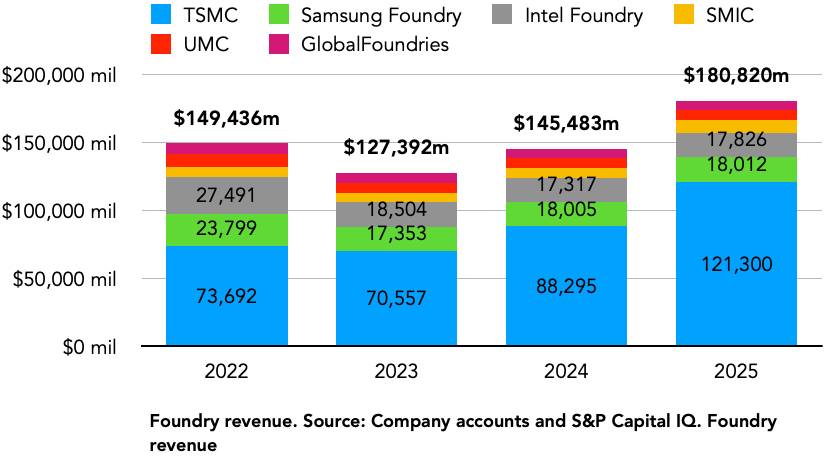
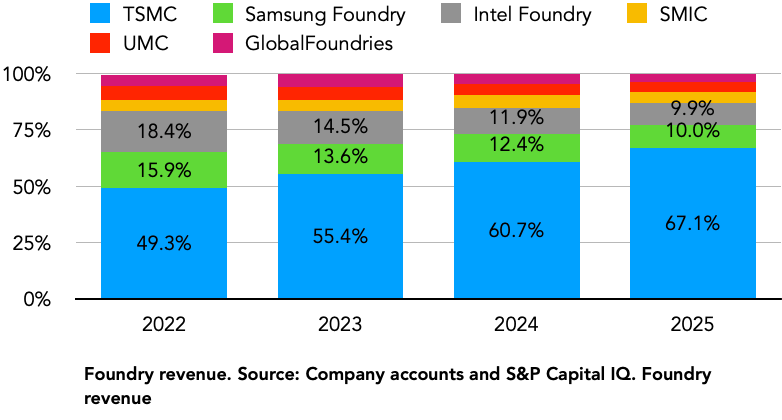
From a more competitive lens, TSMC’s revenue share among the six major listed foundries increased from 61% to 67% in 2025, achieving three times as much revenue as Intel and Samsung foundries combined.
It might be tempting to project this growth gap between TSMC and its peers for years to come but as we discussed during the investment case, 2025 was the perfect storm for TSMC because the latest 3-nanometer process node, being the last major TSMC node based on FinFET transistor architecture meant the ROI for other leading-edge foundries like Samsung and Intel expanding production and R&D was much less than prior years.
“Today’s technology is so complicated. So, once you want to design a very complete or advanced technology, it takes 2 to 3 years to fully utilise that technology. After 2 to 3 years of preparation, you can design your product. Once you get your product approved, it takes another 1 to 2 years to ramp it up” - Q4 2025 TSMC earnings call. Che-Chia Wei, CEO of TSMC
Leading-Edge process nodes
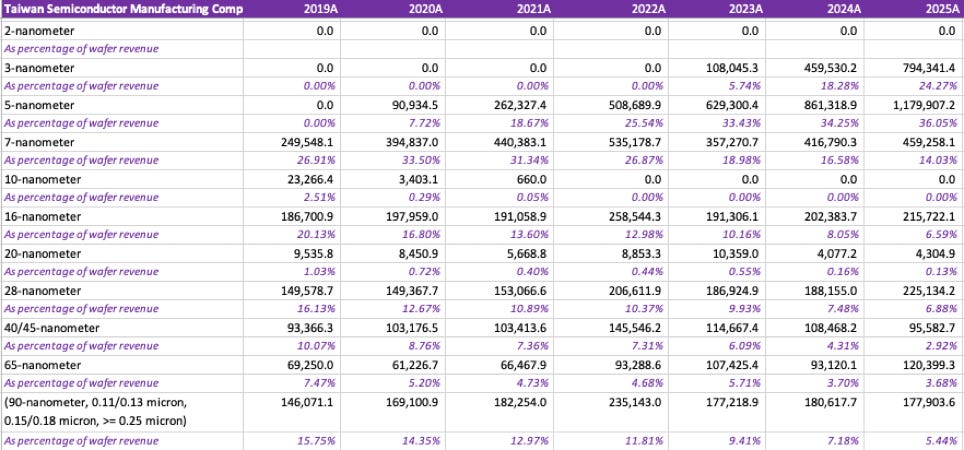
TSMC’s most leading-edge process node historically reaches 25% of TSMC’s wafer revenue by the third year and in 2025, the 3-nanometer node came in just under the historical hurdle at 24.3% and while it might be tempting to say it has so far underperformed, I think the more important takeaway is the staying power of the 5-nanometer process nodes, now in its sixth year, growing 37% year on year. For context, the 7-nanometer node revenue fell 33% in its sixth year (2023) and was already much smaller than the 5-nanometer node.
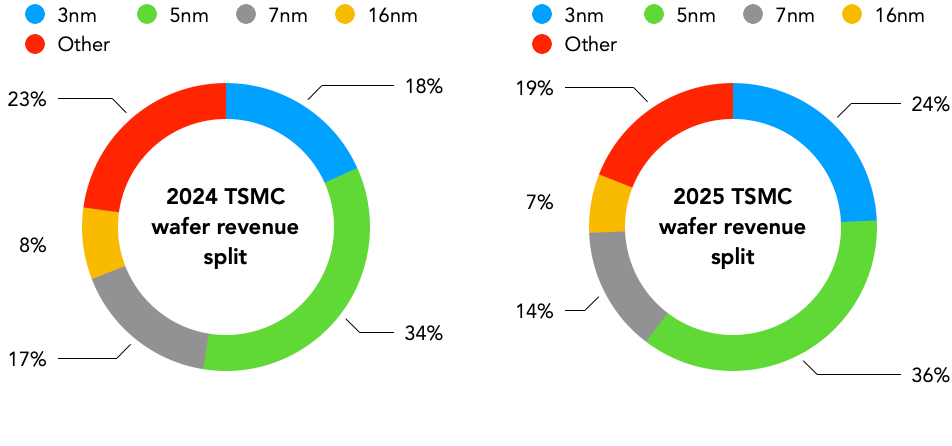
While TSMC doesn’t reveal its process node revenue by customers, I suspect its AI accelerator chips, the data centre custom chips and Nvidia’s H200 (currently utilising the 5-nanometer process node, TSMC N4) continue to drive its demand.
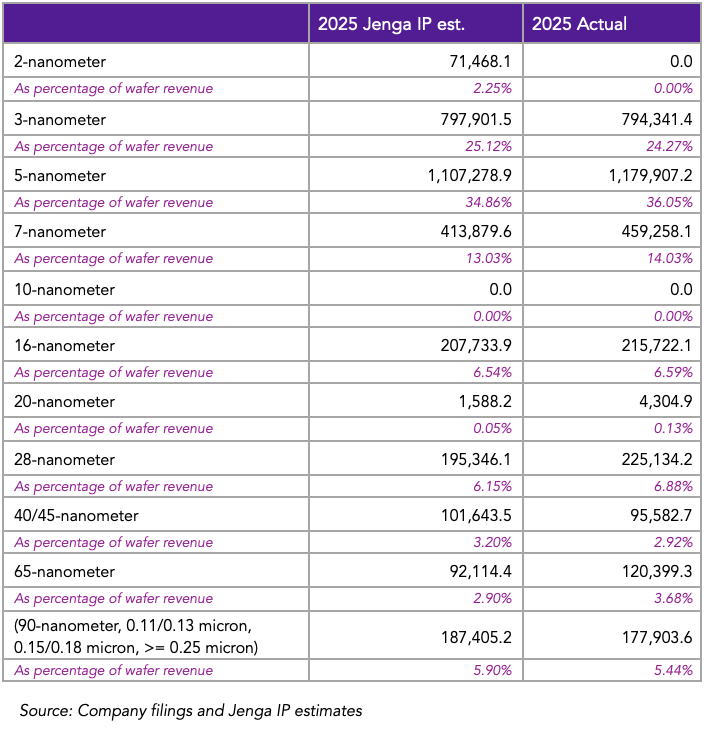
Although my 2025 wafer revenue estimates weren’t too far off from TSMC’s actual performance, I underestimated the staying power of both the 5-nanometer and 7-nanometer process nodes, as their wafer revenue was ahead of my estimates. For 2026, management discussed how they’re optimising capacity as they prepare for more demand in the 3-nanometer process nodes relative to both 5 and 7-nanometer:
“In addition to all the new fabs, we continue to convert 5-nanometer tool to support 3-nanometer capacity in Taiwan” - Q1 2026 TSMC earnings call. Che-Chia Wei, CEO of TSMC
Another interesting update was on the future process nodes, the 2-nanometer and A14 process nodes. The 2-nanometer node introduces a fundamentally new technology architecture, and both Intel and Samsung are more focused on achieving market share growth in this process node, over the current 3-nanometer nodes.
Earlier today, Apple, TSMC’s second-largest customer, was rumoured to be in preliminary talks with Intel and Samsung, which deviates from the exclusive partnership it had with TSMC from its iPhone 8 (2017) to the iPhone 17 generation.
Since my initial deep dive, the two leading-edge competitors, Intel and Samsung, are also in a much better financial position, publishing better financial outlooks than I imagined. For example, the memory chip market shortage has worked in Samsung’s favour, with the division representing 90% of Samsung’s operating profit growth in 2025. The additional profits here can be reallocated to supporting investments in its logic foundry business, leading to a more competitive market than we saw in 2025.
Capacity and fab expansion
The second biggest growth driver for TSMC is its capacity expansion, particularly across its most advanced chips, and capacity continues to track well, with new fabs across Arizona, Taiwan, Japan and Germany in line with the schedule. In Arizona, TSMC mentioned it is speeding up production due to customer demand:
“Construction of our second fab is already complete and tool moving and installation is planned in 2026. Due to the strong demand from our customers, we are also putting forward the production schedule and now expect to enter high-volume manufacturing in the second half of 2027” - Q4 2025 TSMC earnings call. Che-Chia Wei, CEO of TSMC
Although the manufacturing scale in Arizona would likely never reach Taiwan’s scale, the fabs here address a major long-term supply chain risk, bringing U.S. chip production onshore, and if TSMC can meet its goal of 30% of 2-nanometer capacity in Arizona, I believe this levels the political narrative relative to leading-edge peers.
Despite its international buildout, TSMC isn’t slowing its domestic capacity growth ambitions and is now preparing for additional 2-nanometer capacity in both Hsinchu and Kaohsiung Science Parks and an A14 processing facility in Taichung (Fab 25) scheduled for H2 2028.
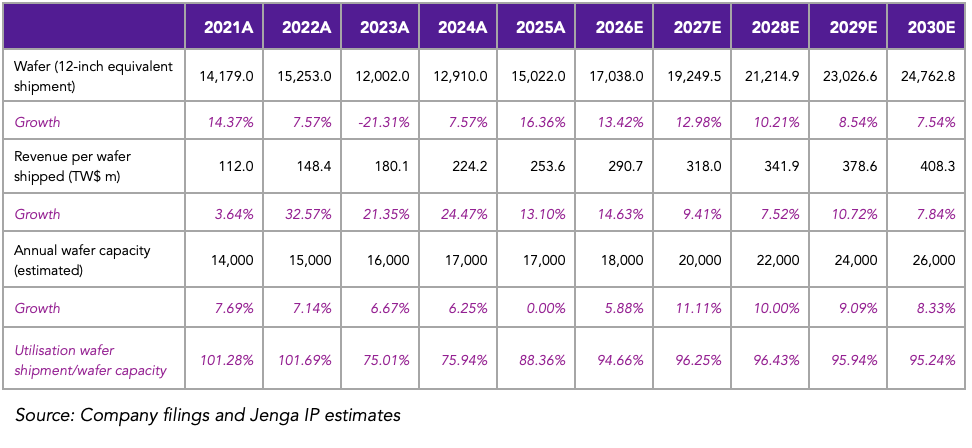
Altogether, it’s clear that TSMC is preparing for even more demand than anticipated in 2024, and I have also increased my wafer capacity and shipment forecasts from 2026 through 2030 (see table below), and expect TSMC to add twice as much capacity in the next 5 years as it did between 2020 and 2025, with utilisation steadily above 95% for the next few years.
AI-led growth
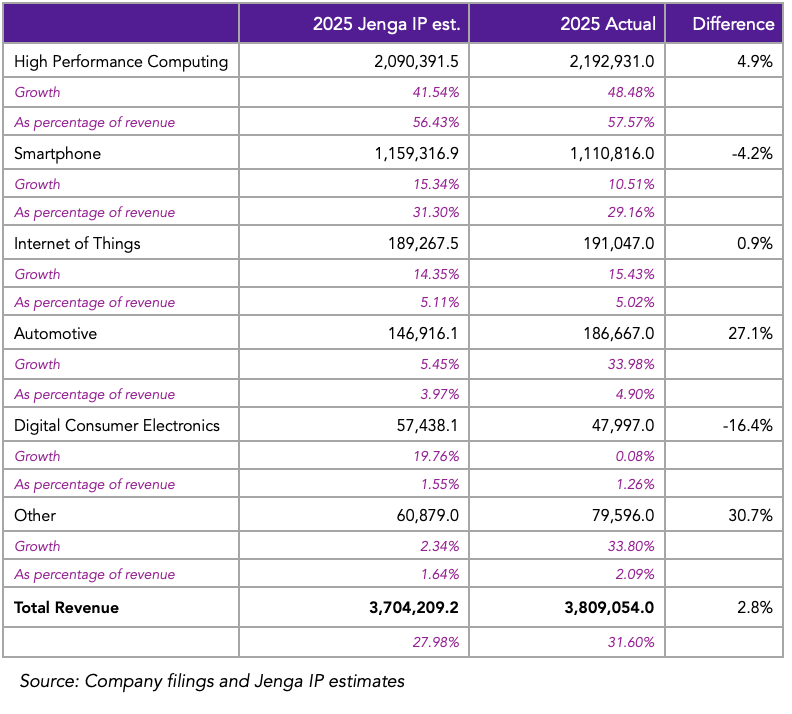
Although it’s still unclear if AI will make TSMC more or less cyclical in the long term when compared to the smartphone era, it’s clear that the growth today is overwhelmingly driven by AI and data centre demand, with the High-Performance Computing (HPC) division reaching 58% of TSMC revenue, from 37% four years ago. Discussing the strong demand outlook, management once again reconfirmed that they expect mid-to-high 50s CAGR between 2024 and 2029 in their AI accelerator business and that it will be the biggest contributor of incremental demand across all its platforms. Today, AI accelerators represent mid-teens of TSMC’s total revenue.
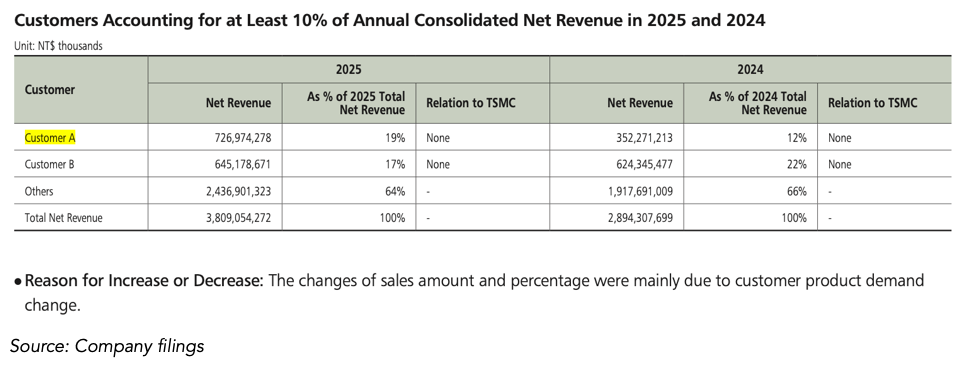
Another interesting data point reflecting the AI growth for TSMC is its customer base, and for the first time in 10 years, Apple isn’t its largest customer and was overtaken by Nvidia, which alone represented 41% of TSMC’s incremental revenue growth.
I wouldn’t be surprised for the gap between Nvidia and Apple to widen for years to come, and internally, I expect Nvidia to reach 25% of TSMC’s revenue by the end of the decade, even as it diversifies its own fab supply chain.
Beyond Nvidia, the industry teardown of other major chips points towards more growth for TSMC. In custom silicon, Amazon’s highly successful Trainium 2 chips are rumoured to leverage TSMC’s CoWoS advanced packaging technology, while TSMC also fabricates Google’s 8th generation of its Tensor Processing Units (TPUs). Altogether, this brings us to even more growth for 2026 and beyond, bringing us to TSMC’s updated valuation.
TSMC’s updated valuation model