


S&P Global (update)
The S&P Global deep dive will be published early next week. It’s our most in-depth research piece to date, and it also covers CRISIL Limited and Mobility Global.
As a disclaimer, I built my position in S&P Global back in October; see here.
My research process is to first question everything, then focus on what matters. For S&P Global, this involved studying:
The relevance, economics and market structure of price reporting agencies (PRAs - Platts)
Wood Makenzie and Rystad Energy’s competitive threat to CERA
Comparing the Kensho Data Platforms perimeter to FactSet and LSEG Workspace, and its potential sale price.
Hyperscalers’ share of ratings current growth, calculating ratings real pricing power, the future of surveillance ratings and what a downturn looks like for ratings.
Indices growth balance between “new flows” and “market appreciation”, and what indices could look like should the S&P 500 stay flat for 5 years.
Assessing the strength of CRISIL’s gap to ICRA and CARE, and the ROIC of its diversification efforts.
Here are three charts from the upcoming deep dive:
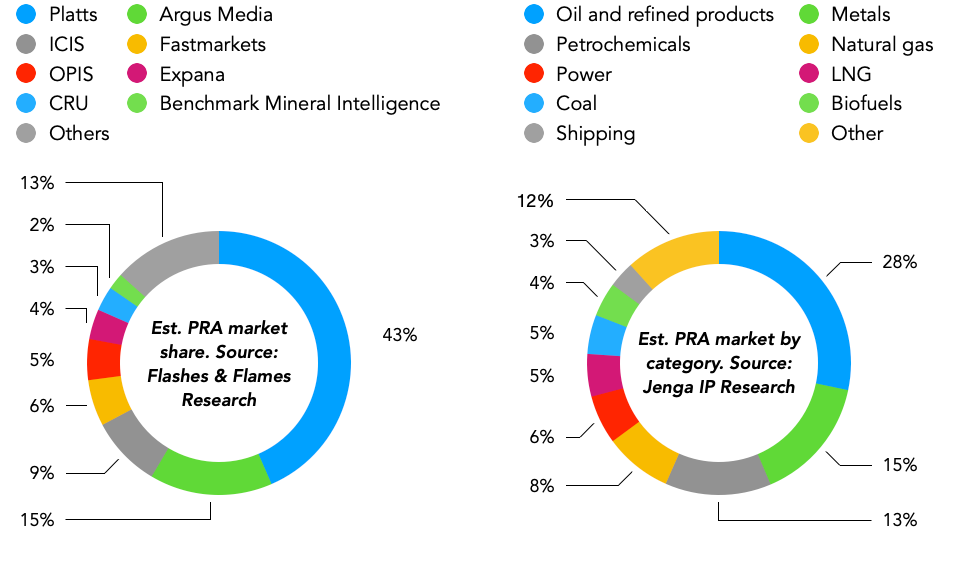
I dive into the world of PRA’s, the categories Platts leads and the potential for additional subscription monetisation.
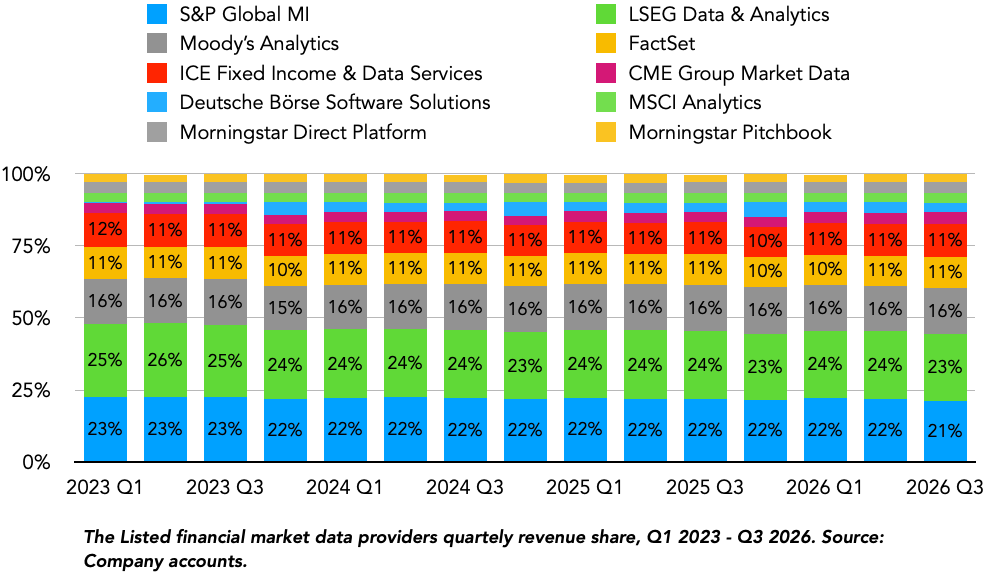
I once again go through the A-Z of the financial market data industry, assessing where S&P’s Market Intelligence sits relative to its listed peers (and Bloomberg) in market share, product depth, pricing model (hint: S&P leads peers in the switch to enterprise agreement from per user, leading to more resilient AI defence) and, most importantly, what price the Kensho Data & Platforms perimeter sale could fetch to PE buyers.
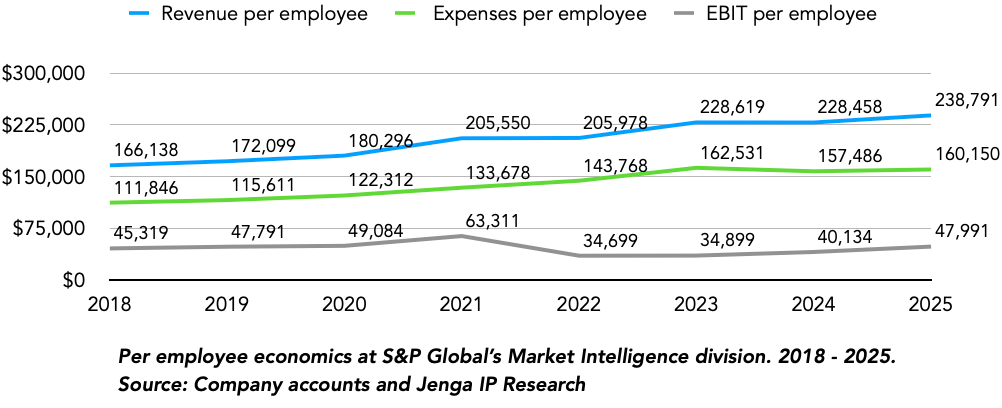
I discuss S&P Market Intelligence’s cost structure, the impact of the implemented enterprise data organisation (EDO), improved sales and pricing structure initiated by Saugata Saha (former MI President) and scope for potential margin expansion.
Benefit Systems (update)
In September, I introduced the Polish fitness subscriptions market leader; see here. While I remain very impressed with my research notes so far, its shares have rallied quite aggressively since then, up 20% in the past month and 72% year to date.
At 25x P/E, the valuation analysis has definitely changed, and it is currently unlikely that I will build an immediate position here. I will still publish my deep dive on them.
Netflix
Due to my research on Benefit Systems, I’ve been thinking more deeply about consumer subscriptions and their resilience during tougher economic climates. While I’m far from a conclusion on Netflix, it fell below a price I believe is worth a full deep dive.
From my initial research overview, Netflix only needs to grow its revenue by 10% CAGR over the next 4-5 years (i.e. add $30 billion in net new revenue, ~110 million new paid customers) to deliver attractive returns. The main question is to what extent it can (or can’t) defend 30% EBIT margins, and you can expect a deep dive on them soon.
ICE (update)
Back in June, see here, I mentioned ICE, S&P Global and CME are all undervalued and are my research priorities, alongside software. Afterwards, for portfolio diversification reasons (40%+ of the Jenga IP portfolio is in financials), I narrowed potential investments to just one, and selected S&P Global.
In hindsight, I should have bought all three, as their shares have each raced higher. ICE, for example, is up 40% since then.
I still plan on publishing my research on ICE right after Benefit Systems. We have already explored areas of financial infrastructure such as payments, market data, ratings and indexes. Exchanges are a natural conclusion to this theme, and you can expect some research on CME and Deutsche Börse in the ICE deep dive too.
2026
While AI is the greatest technological shift today, several very high quality companies have also gone on sale at once-in-a-decade prices due to their perceived negative AI impact:
ICE 15x, CME Group 17x and S&P Global 19x
Visa and Mastercard - 22x (yes, 22x is low for them!)
These were my 2026 priorities, and so far, we’ve seen some recovery in the theme. The focus, though, is on the long term, over 4-5 years, and I’ll track how these companies evolve over time.
These were my 2026 priorities: studying these companies and waiting for a good price. There’s been a late rebound in their shares. But don’t get excited yet; the focus is always on the long term: 4 to 5 years out. We still have a long way to go.
For 2027, I suspect I’ll be focusing on companies with more limited “AI-disruption” risks, similar to industrial companies I’ve covered like airports, ports and industrial groups (Metlen and Latour).